
Understanding What Prime Numbers Are: Definition and Methods for Identification
Saturday, November 16, 2024

Ever found yourself scratching your head over prime numbers? You’re not alone! Many people struggle to understand what makes a number prime and how to tell the difference between prime numbers and composite numbers. If you have ever asked yourself why some numbers e.g. or are special and some like or aren't, you are on the right page.
In this guide, I’ll take you through the world of prime numbers step by step, breaking it down in a way that’s easy to grasp. By the end, you'll not only understand prime numbers, but you'll also feel confident identifying them on your own. Let’s start now!
What are Prime Numbers
Prime numbers are a special group of numbers that have exactly two factors: There is the number and the number itself. In other words, a prime number can be divided only by and itself with no reminder. This simple definition sets prime numbers apart from composite numbers, which can be divided by more than two factors. For example, take a number . It’s only prime as it turns out, for it’s only divisible by and . The composite number, on the other hand, has a number 6 that can be divided by , , , and . I'll look at a number that has one factor (like or ) and it’s not a prime number since it does not satisfy the two-factor requirement. Prime numbers hold an important place in number theory and serve as the "building blocks" of all other numbers. Any number greater than is either a prime number or a composite number, which can be broken down into smaller prime numbers.
What are Prime Numbers to
If you're curious about prime numbers, the first 100 numbers offer an excellent playground to explore. From to , there are exactly 25 prime numbers. These numbers include some classics like , , , and , but also many others that you might not immediately think of, like and .
Here’s a list of prime numbers between and :

, , , , , , , , , , , , , , , , , , , , , , , , .
Please note that is the only even number on this list—making it a standout in the world of prime numbers. Every other prime number is odd.
How to Tell if a Number is Prime
There doesn’t seem to be anything tricky about determining whether a number is prime – until you see how to do it. The number greater than can be divided only by and itself is a prime number. The easiest thing to do, of course, is to see if you can divide it by other numbers. Congrats! If none of the smaller numbers divide evenly. The number is prime.
For example, take .

Or, you can try to divide it by , , , , and so on. Since none of these numbers divide without leaving a remainder, is a prime number.
And other more sophisticated methods for primality tests too. There is one method known as trial division, dividing a number by all primes smaller or equal to its square root. In that case, if none of these primes go into the number, it’s prime.
Prime Numbers Vs Composite Numbers
It’s important to know the difference between prime numbers and composite numbers. Prime numbers, as we mentioned earlier, have exactly two divisors: and the number itself. These, however, are the only numbers that would have more than two divisors. You can divide it by smaller numbers and get a product. So let’s compare the numbers and . The number of prime numbers in the number is that and divides it. However, is a composite number because it can also be divided by and . It is this distinction that helps to define number theory. Prime numbers are unique in that they cannot be broken down further. Composite numbers, however, can be factored into smaller prime numbers. For example, the number is a composite number, which can be factored as , which are all primes.
Solved Examples of Prime Numbers
To grasp the concept of prime numbers, it helps to work through a few examples. Let’s tackle some different types of problems that test your understanding of prime numbers in various ways.
Basic Prime Number Identification
Question: Is the number a prime number?
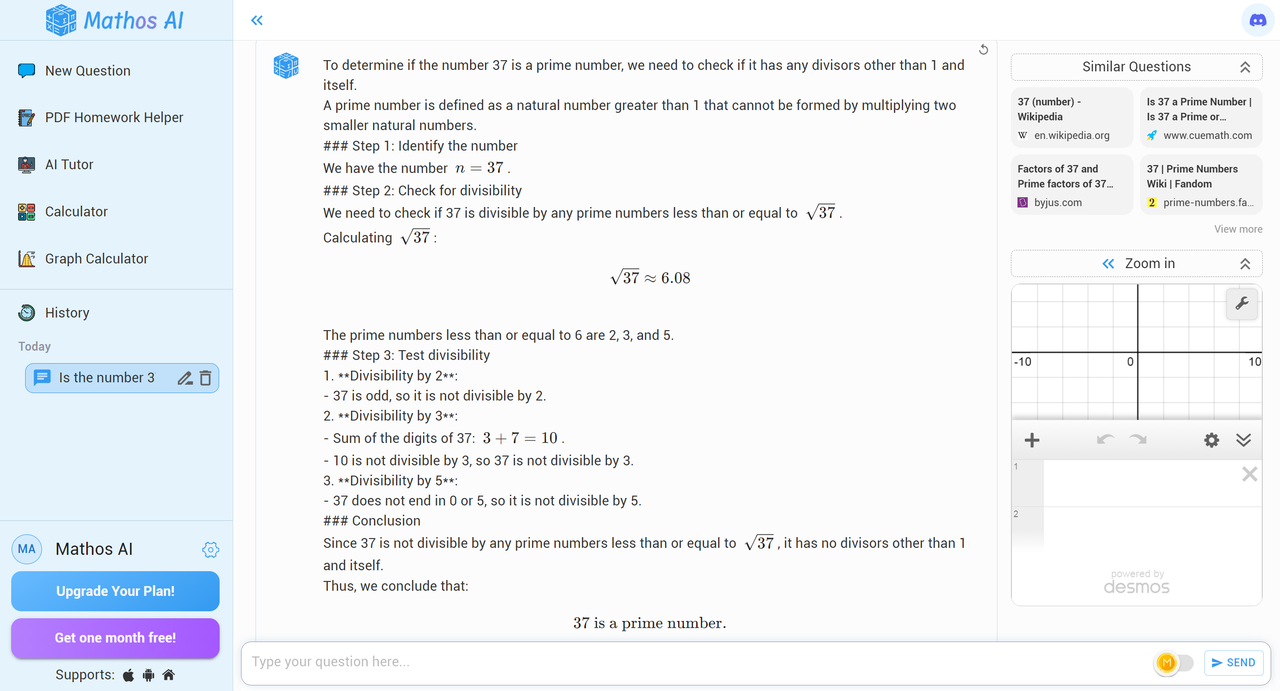
Solution: To determine if 37 is prime, we need to check if it has only two factors: and itself. Try dividing by smaller numbers like , , , and so on. None of them divide evenly into , meaning it cannot be factored by any numbers other than and . Therefore, is a prime number.
Mathos AI's answer:
Finding Prime Numbers in a Range
Question: How many prime numbers are there between and ?
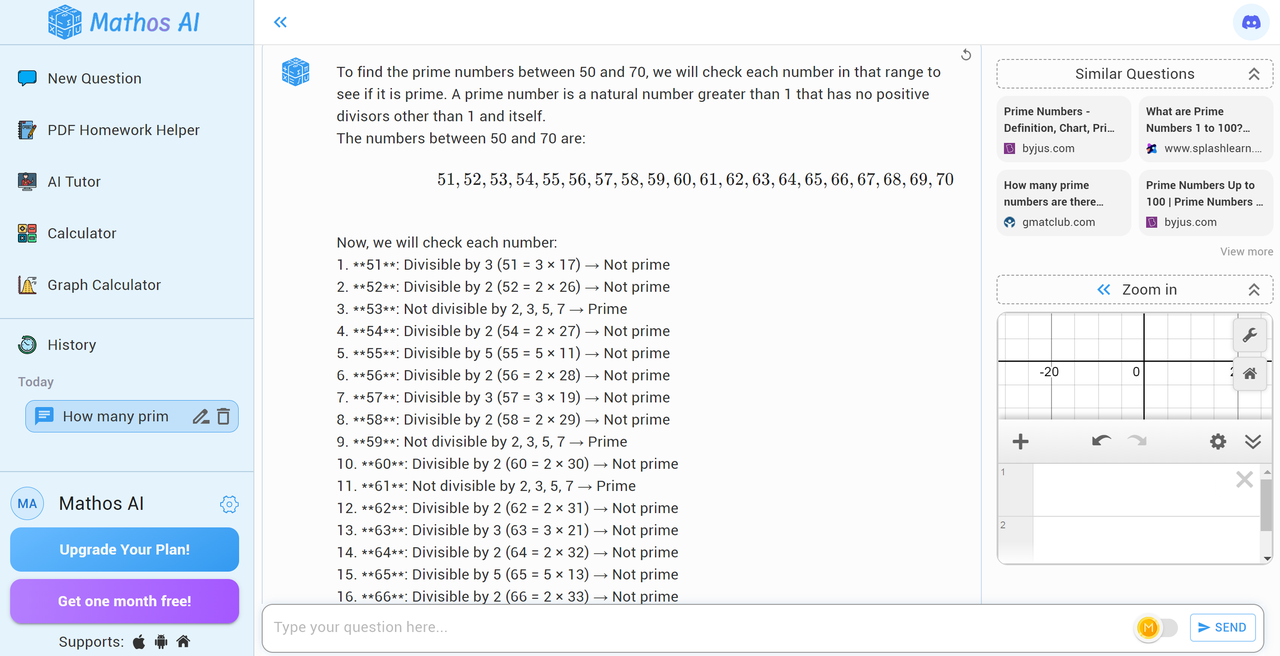
Solution: To solve this, let's check each number between and :
- is divisible by (composite)
- is only divisible by and (prime)
- is divisible by (composite)
- is divisible by (composite)
- is only divisible by and (prime)
- is only divisible by and (prime)
- is divisible by (composite)
- is divisible by (composite)
- is only divisible by and (prime)
- is divisible by (composite)
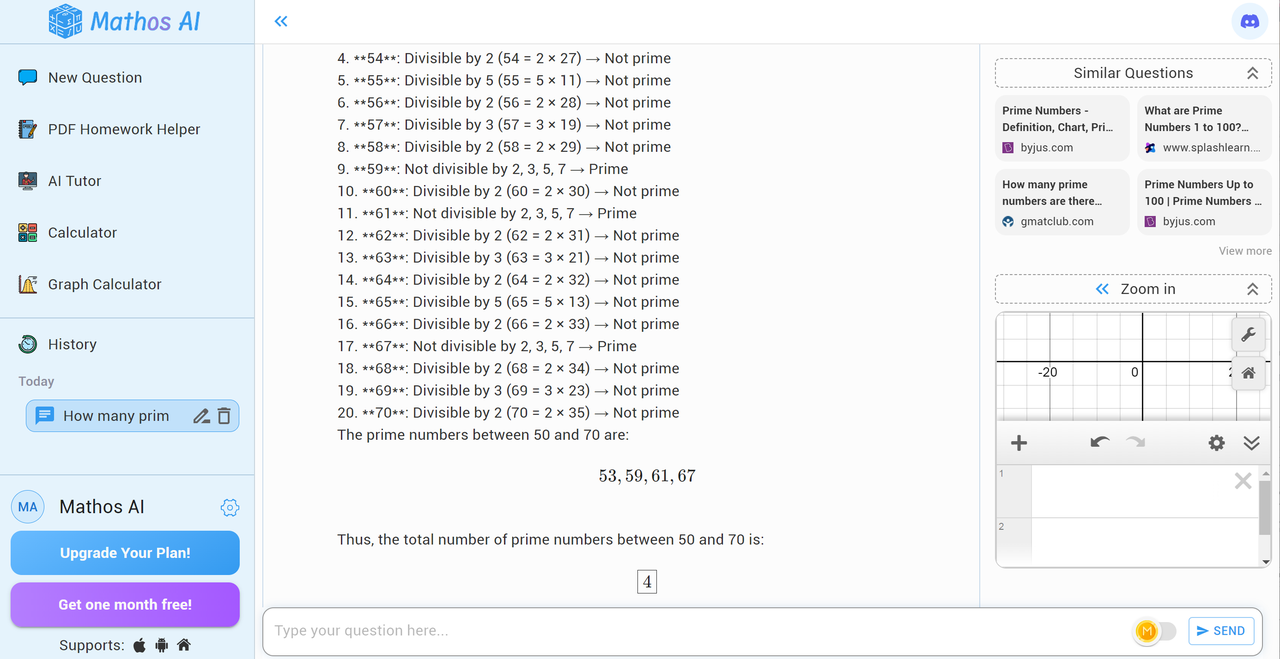
So, the prime numbers between and are , , , and . That gives us a total of 4 prime numbers.
Mathos AI's answer:
Composite vs. Prime Number Comparison
Question: Is a prime number or a composite number?
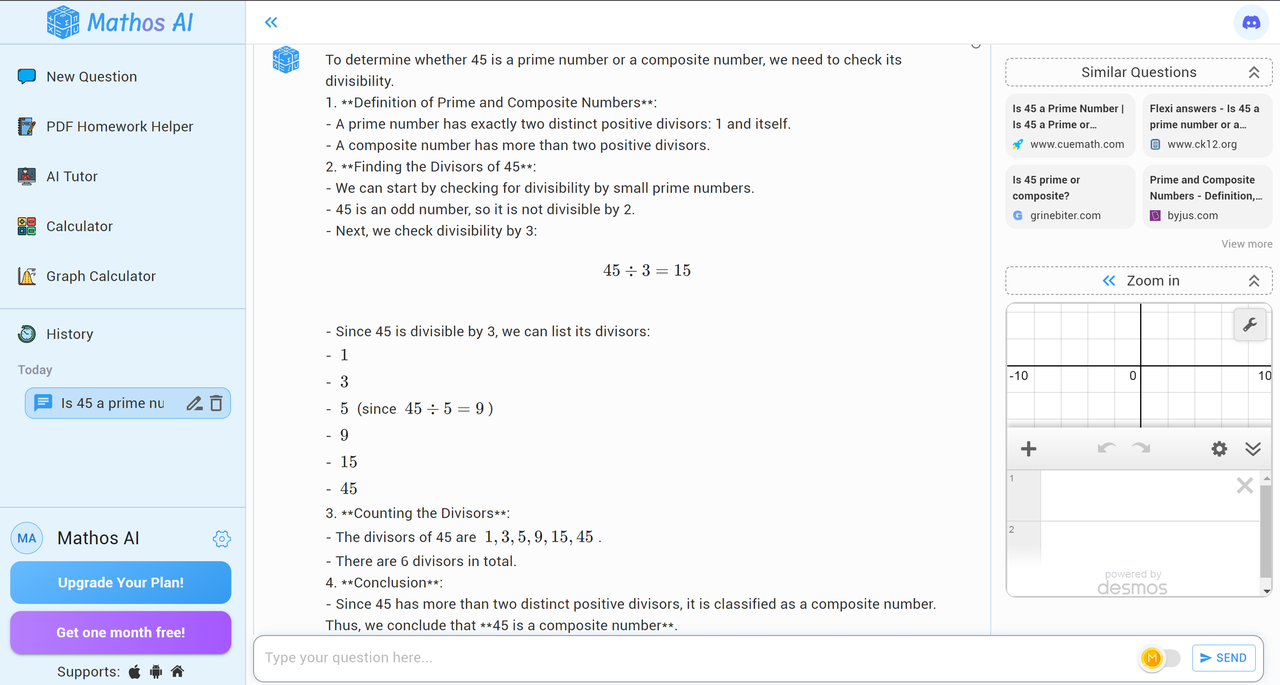
Solution: For a number to be prime, it should only have two factors: and itself. Let's check . It can be divided by , , , , , and , meaning it has more than two factors. Since has multiple divisors, it is a composite number.
Mathos AI's answer:
By practicing these examples, you’ll see that identifying prime numbers is all about checking how many divisors a number has and ensuring it's only divisible by and itself.
Ready to Master Prime Numbers?
By now, you should have a much clearer understanding of prime numbers—what they are, how to identify them, and why they’re so important in mathematics. It’s normal if you still feel a little unsure, especially when it comes to differentiating between prime numbers and composite numbers. I’ve been there too! But trust me, with a bit of practice, prime numbers will soon make perfect sense, and you'll be spotting them easily.
Mathos AI is a great way to help you along the way if you’re looking for even more! This is a fantastically designed tool with rich free online calculators for solving math problems quickly and comprehensively right in the browser. With the help of Mathos AI's calculators, you get help with basic math, algebra, or more advanced functions such as integrals or matrix multiplication. Perfect for students, professionals, or casual math enthusiasts like us. I’m using it as my go-to resource for asking math questions and finding solutions. PDF Homework Helper from Mathos AI can be your trick to studying smarter and more efficiently!
Why stop at prime numbers? Mathos AI helps you confidently dig deeper into math, the world of numbers!