
Trigonometry Made Simple: Meaning, Formulas, Identities, and Example
Saturday, November 16, 2024
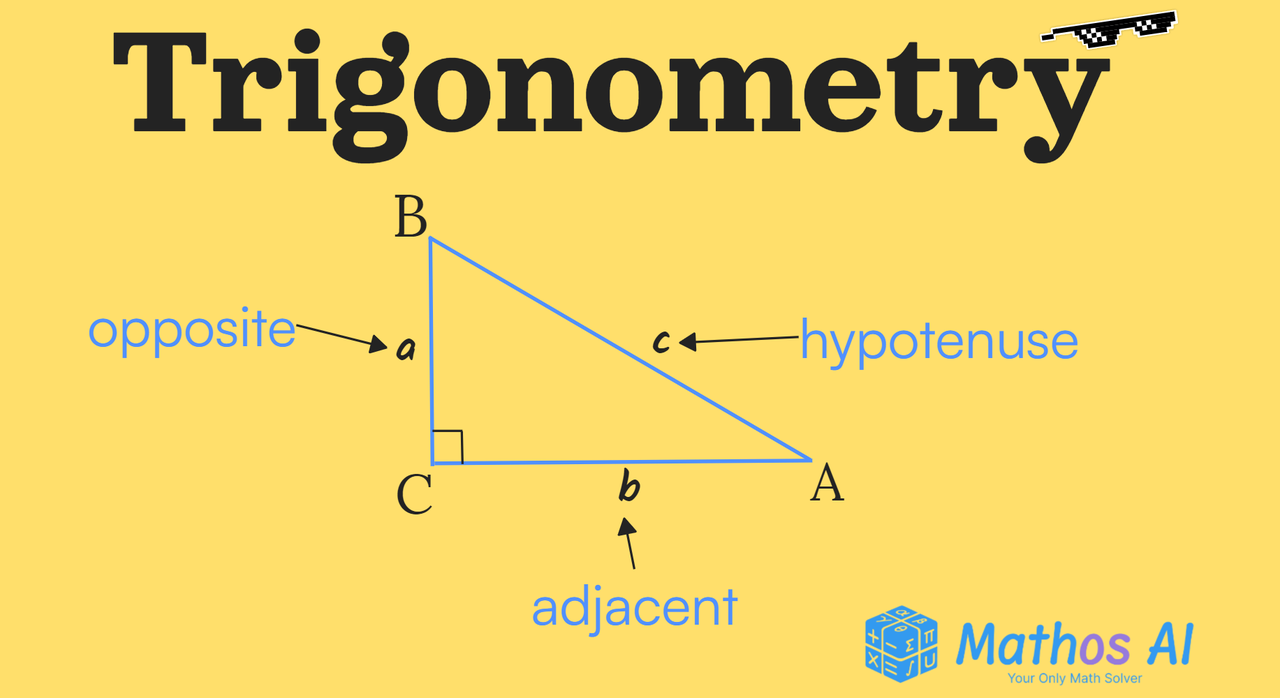
Trigonometry sounds intense, doesn’t it? Even the name in its simplest abbreviation looks like the statement – This is serious mathematics. But hold on! Once you get the basics down, trigonometry is less intimidating than it seems. At its core, trigonometry is simply about triangles and the relationships between their angles and sides. With trigonometry, we can figure out the unknown parts of a triangle as long as we have enough known information. Interested to know, from what angle you can make the best basketball shot? Perhaps you have wondered how surveyors determine the height of a mountain. That’s all trigonometry in action!
Even better, we now have advanced tools, like Mathos AI’s trigonometry calculator, to make these calculations a breeze. So, let’s dive in, explore the basics of trigonometry, and see how these ancient techniques connect to the modern world.
What is Trigonometry?
The term "trigonometry" comes from two Greek words: The term origination; the word “trigonon,” which translates to “triangle,” and “metron,” which translates to “measure.” At its heart, trigonometry is about measuring angles and sides in triangles. For students and professionals alike, trigonometry is a powerful tool that links geometry with algebra. With trig, you can find unknown sides and angles, even if that’s all that’s given to you in terms of hints. Historically, trigonometry emerged in ancient Greece as a way to understand the heavens. For Greeks, it was used in mathematics to determine the positions of stars. In India, mathematicians developed early tables of trigonometric ratios, laying the groundwork for modern trigonometry. In short, trigonometry has been evolving for centuries, and today it serves as a foundation for math, science, and engineering.
The Origins of Trigonometry
Trigonometry can feel like a tangled web of mysterious origins and debates about who really invented it. So let's break it down in simple terms for those curious minds who have ever wondered, who is the real founder of trigonometry? or Did ancient civilizations like the Egyptians really know trigonometry?
Who Invented Trigonometry?
Pinpointing the exact inventor of trigonometry is tricky because its roots stretch back to different regions and eras. However, the most widely accepted answer is Hipparchus of Nicaea, who lived around 161-127 BCE. Known as the "Father of Trigonometry," Hipparchus created the first trigonometric tables, focusing on the chords of a circle. Even though his actual work has been lost over time, historians believe he wrote about twelve books filled with chord calculations. By figuring out the length of the chord subtended by a given angle, he laid down the early groundwork for trigonometric functions.
But let’s not forget the Babylonians, who were already playing with angles way before Hipparchus. They were the first to divide a circle into 360 degrees — a number they chose because their calendar had roughly 360 days. This is also why we use degrees in measurements today. Interestingly, they were using something like a protractor to measure star positions long before trigonometry became its branch of mathematics.
Did the Ancient Egyptians Know Trigonometry?
Surprisingly, the story of trigonometry doesn’t start with the Greeks or Babylonians. Early hints of "proto-trigonometry" date back to ancient Egypt, around 1850 BCE. An old papyrus scroll describes how they used mathematical techniques to construct the great pyramids. Now, did they have trigonometric functions as we know them? Not exactly. They applied basic math concepts to ensure their architectural wonders stood tall and straight, but they didn't necessarily see trigonometry as a separate science. Their calculations were more about getting things built right, not about solving mathematical problems for fun.
Trigonometry Spreads Across the World
While the Greeks took trigonometry to new heights, it was the Islamic Golden Age that truly made it flourish. The Quran didn’t invent trigonometry, but scholars in Islamic civilizations refined and expanded it. Mathematicians like Nasir al-Din al-Tusi in the 13th century made trigonometry a discipline in its own right, separate from astronomy. If anyone could be called the "father of trigonometry in Islam," it would be him. He was known for transforming it into a more structured field, leading to advancements that would later shape modern mathematics.
Fast forward to the 15th century, and we see Jamshīd al-Kāshī making waves with his contributions. He was the first to clearly state the Law of Cosines, which is essential for solving triangles. His work helped move trigonometry beyond just circles and angles to practical applications like navigation and triangulation.
So, who invented trigonometry? The answer is a collective effort across centuries and civilizations. From the early measurements by the Egyptians and Babylonians to the detailed mathematical theories of the Greeks and the refined methods by Islamic scholars, trigonometry is the result of shared human curiosity.
FAQs About Trigonometry's Origins
- Who is the real founder of trigonometry?
- While many contributed, Hipparchus of Nicaea is generally credited as the father of trigonometry due to his development of the first trigonometric tables.
- Did the Quran invent trigonometry?
- No, but scholars in the Islamic Golden Age made significant advances in the field, transforming it into a well-defined branch of mathematics.
- Who first invented trigonometry?
- It began with ancient civilizations like the Babylonians, but it was the Greeks, especially Hipparchus, who truly established it as a mathematical discipline.
- Who is the father of trigonometry in Islam?
- Nasir al-Din al-Tusi is often credited for elevating trigonometry to a standalone subject, separating it from astronomy.
Trigonometric Functions You Need to Know
Trigonometry is the beautiful thing that works as Math’s hidden formula. Rather than measure these features, we employ sine, cosine, and tangent functions to learn about the sides and angles of a right-angled triangle without actually getting a measuring tool.
The Big Three: Sine, Cosine, and Tangent
- Sine (): The sine of an angle is defined as the ratio of the side opposite to the angle divided by the side opposite to the right angle of the triangle. Think of it like this: if you are at one vertex of the triangular figure then the sine reveals to you how far away the other vertex is to the hypotenuse.
- Cosine (): Cosine compares the length of the immediately smaller transversal, the adjacent side, to the hypotenuse. Some people think of it just as the next-door neighbor.
- Tangent (): Tangent is about comparing the opposite side with the adjacent side of the right triangle. And if sine and cosine are not a lot, then comes tangent to make it even more complicated by dividing these two ratios.
Beyond the basic functions, there are three additional ratios: You are also introduced to the reciprocal trigonometric functions including; co-tangent (), secant (), and cosecant (). These are the less-used, but significant functions and are simply the reciprocals of tangent, cosine, and sine, respectively. While they might not be daily operations for high school children, they come in handy in matters of trigonometry at a high level.
Trigonometry Identities
Now, let’s talk about trigonometry identities. These are formulas that involve relating one or more trigonometric functions in such a way as to simplify an expression or to provide a solution to a certain equation. For instance:
- The Pythagorean Identity: This states that . This identity helps verify or simplify trigonometric expressions.
- Reciprocal Identities: These include expressions like , allowing us to switch between trigonometric functions with ease.
- Angle Sum and Difference Identities: These identities help calculate the sine, cosine, or tangent of the sum or difference of two angles, such as .
With trigonometry identities, you can rewrite and simplify trigonometric formulas, making it easier to solve equations.
How to Do Trigonometry with a Trigonometry Calculator?
A trigonometry calculator like Mathos AI’s can help you find sine, cosine, and tangent values for any angle, solve for missing sides, and more. By making just a few simple inputs, you can get answers to any problem regarding right triangles in addition to detailed, fully explained solutions. To better explain this, let’s walk through a trigonometry question that could be on a class 10 math test.
Trigonometry High School Exam Required Questions
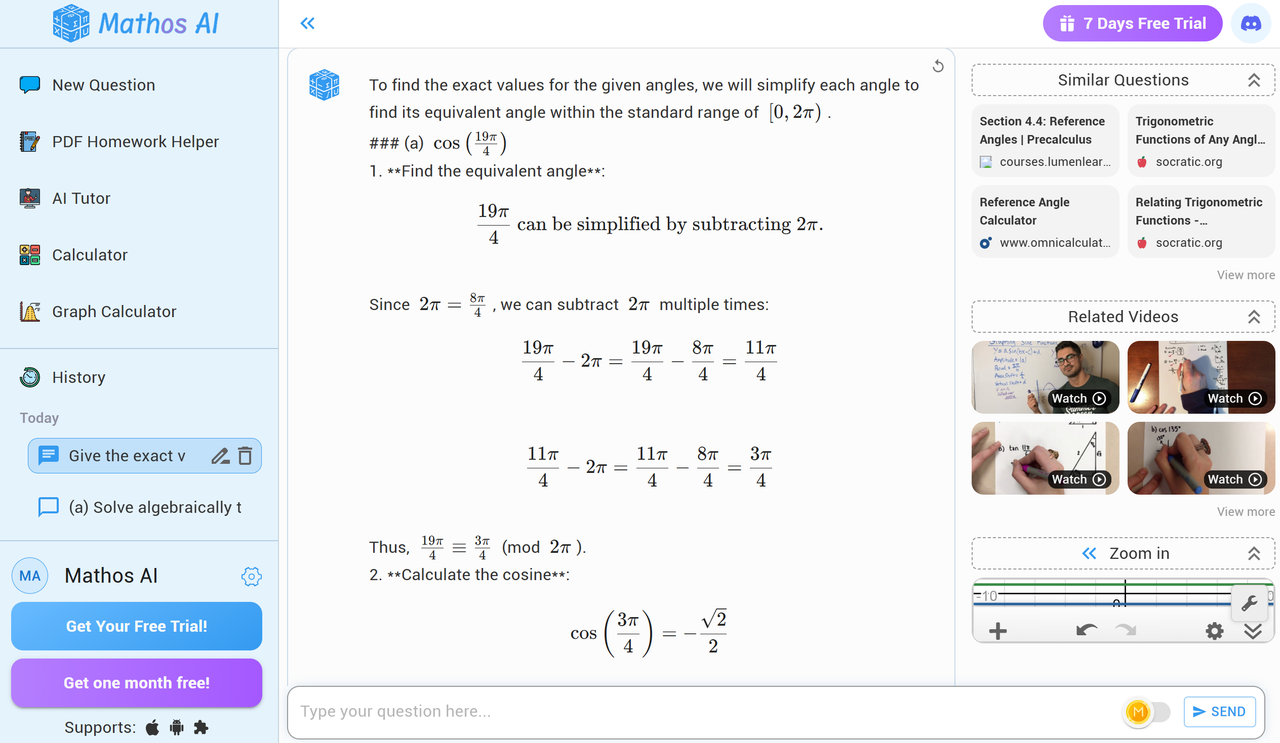
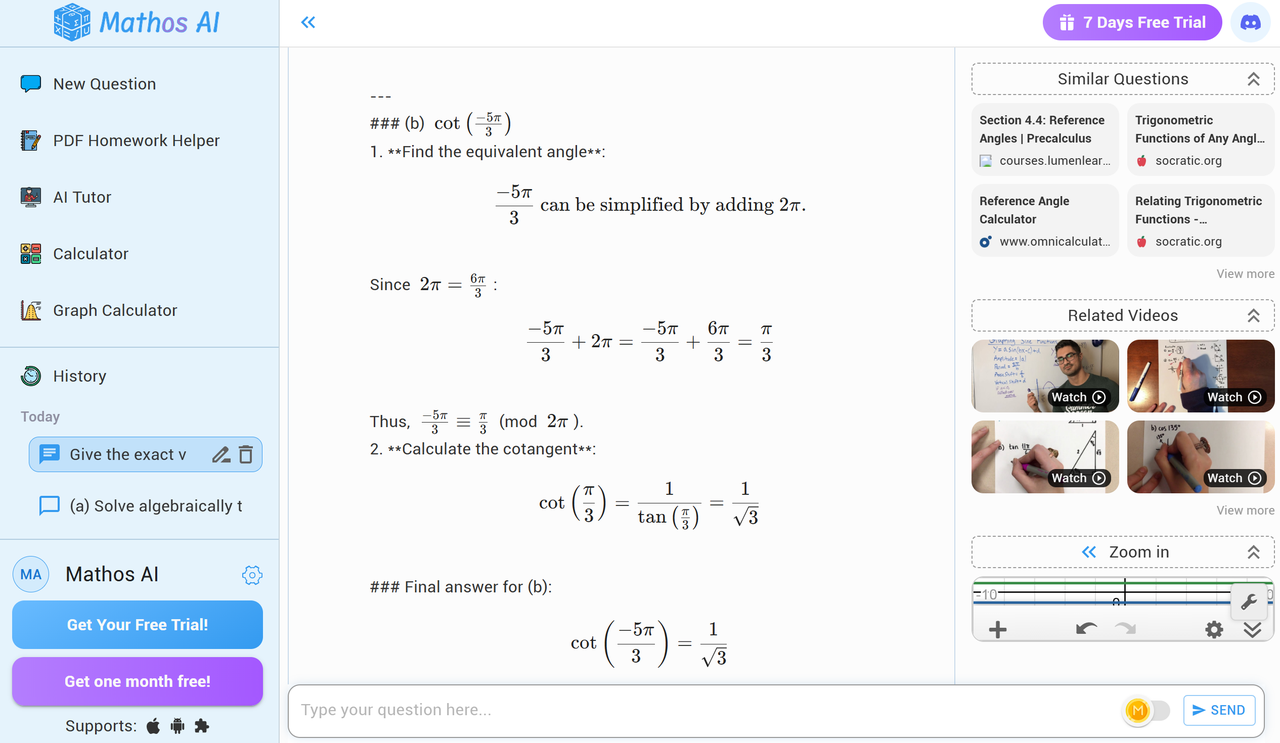
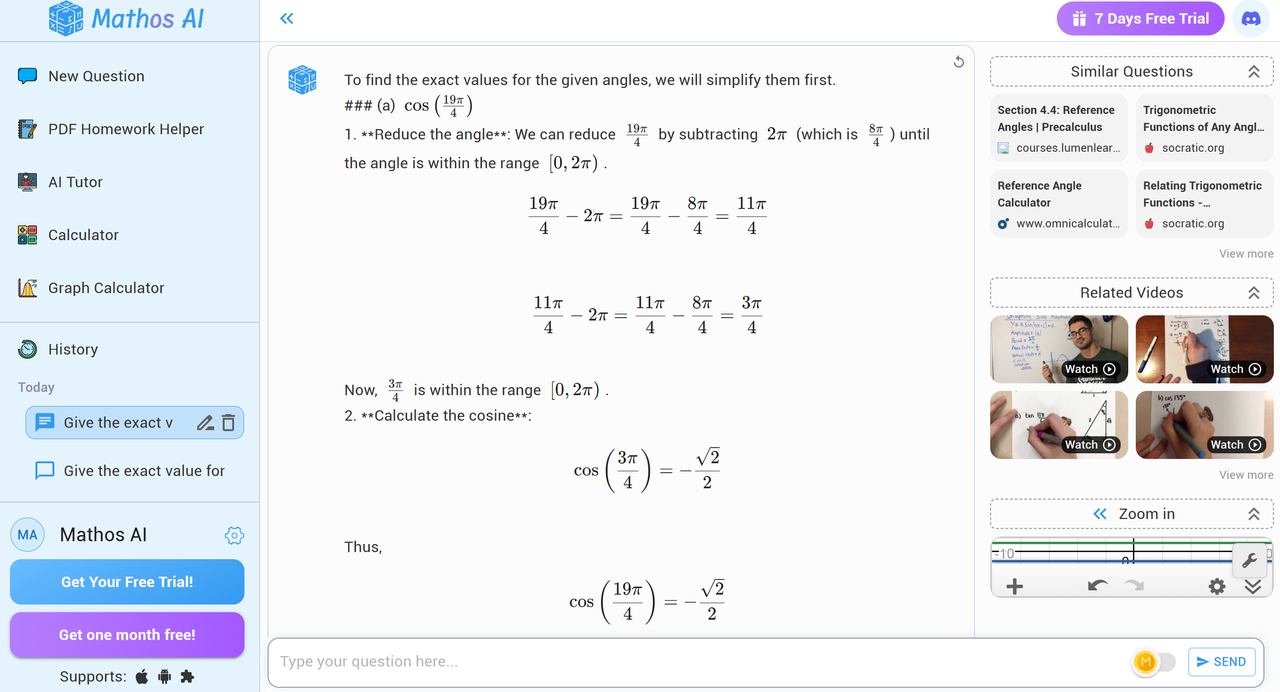
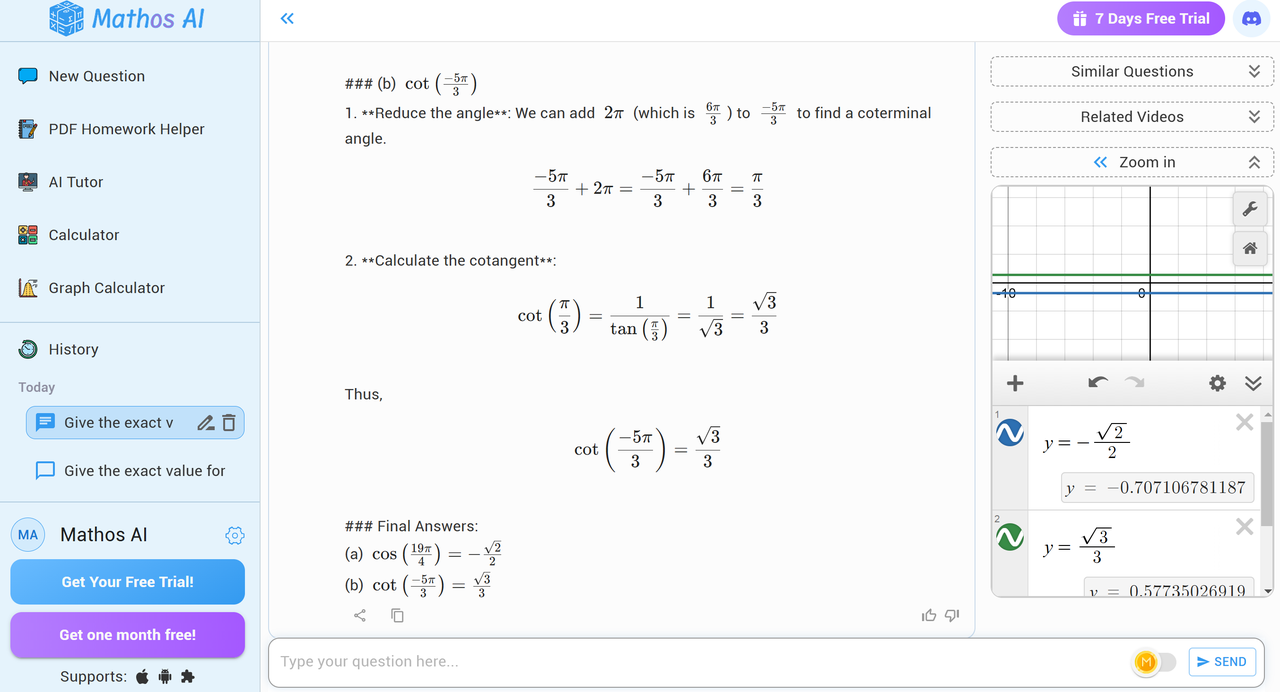
Senior High Math League 2001: Give the exact value for each of the following where the angle is given in radians:
(a) ; (b)
Key points: Tests the ability to find exact values of trigonometric functions, such as cosine and cotangent, for given angles in radians.
Mathos AI's answer:
Trigonometry College Exam Required Questions
College of the Ozarks Trigonometric Functions Test 2010: What is the range of the cosine function?
(a) all real numbers greater than or equal to ;
(b) all real numbers greater than or equal to or less than or equal to ;
(c) all real numbers from to , inclusive;
(d) all real numbers;
Key point: Tests knowledge of the range of trigonometric functions, specifically the cosine function. Requires understanding of the behavior and limits of cosine values on the real number line.
Mathos AI's answer:
Trigonometry Required Question for SAT
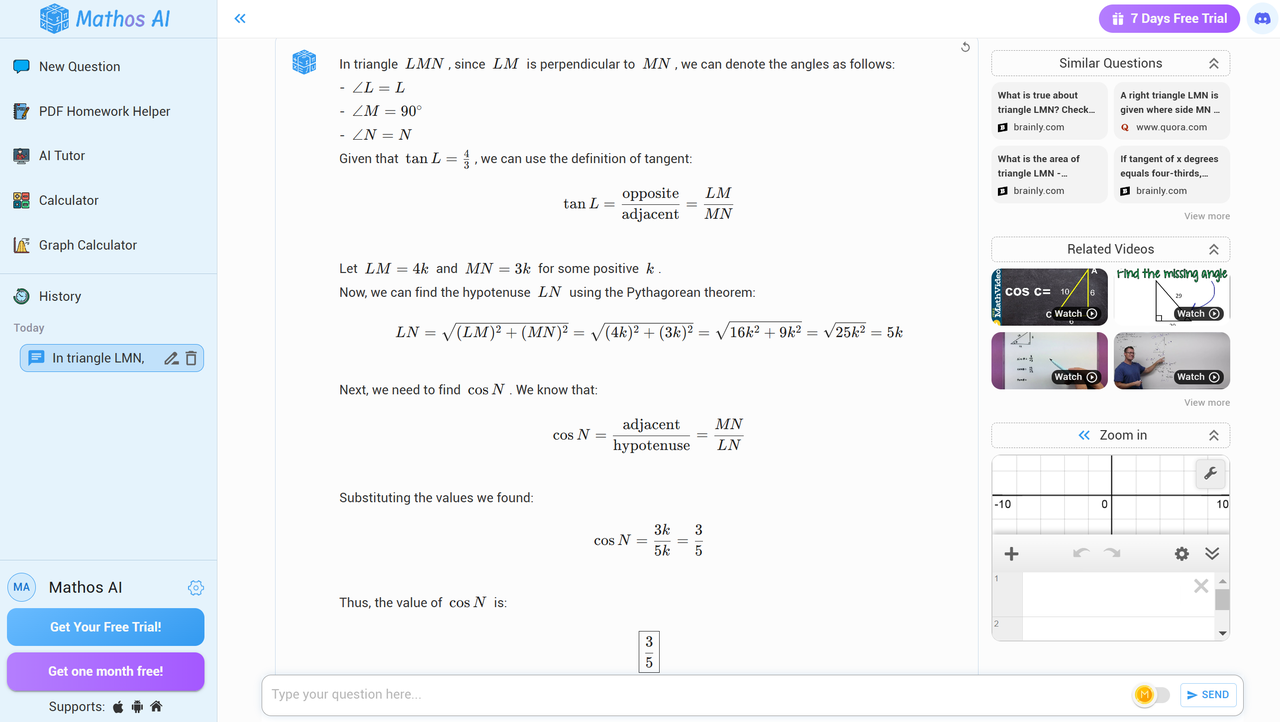
In triangle LMN, LM is perpendicular to MN. If so, what is the value of ?
Key points: Tests understanding of relationships between tangent and cosine in right triangles and complementary angles.
Mathos AI's answer:
Say “Goodbye” to Trig Troubles with a Little Help from AI
Trigonometry doesn’t have to feel like a mystery wrapped in a triangle. With Mathos AI’s smart tools—like our free math calculator, graphing calculator, and AI math solver—you’ll have all the help you need to solve derivative questions, Taylor Series questions, easy "how to add fraction" math questions, and beyond. Whether you’re stuck on a trigonometry problem, need a PDF homework helper where you can upload homework (in pdf) by simply circling you will get an instant solution with detailed explanations, or you just want to ask math questions at any time, we’ve got you covered. Why try to solve angles and equations independently when Mathos AI contains written and audio solutions for everything? Just type in your trigonometric function or angle into Mathos AI Trigonometry Calculator and within the blink of an eye, it provides the step-by-step solution along with an option to expand the results and check out some useful resources of videos/webpages.

Whether you’re solving complex problems in algebra, calculus, or any other math subject, the AI-powered tutor can recognize your study materials, handwriting, and voice inputs, providing tailored, real-time guidance that adapts to your unique learning style.
Wow to your ability and learn how easy math can be!