
Rhombus: Definition, Properties & Area Formula
Thursday, December 12, 2024

Shapes are everywhere—from the tiles on your floor to the diamonds in playing cards! One shape that stands out in math class and daily life is the rhombus. But what exactly is a rhombus? Why is it so special? And how does it show up in real-world problems?
When you finish reading, you'll know how to identify, define, and use this fascinating shape, making geometry less mysterious and much more fun!
What Is a Rhombus?
Let’s start simple: a rhombus is a four-sided shape where all the sides are of equal length. Think of it as a tilted square or a diamond on a playing card. Unlike a square, the angles of a rhombus aren’t always 90 degrees, which gives it that distinct slanted look.
In math terms, a rhombus is a type of parallelogram, which means opposite sides are parallel, and opposite angles are equal. The special thing about a rhombus is that it always has equal-length sides—like a perfect diamond!
Properties and Characteristics of a Rhombus
Understanding the properties of a rhombus is like unlocking a treasure chest of geometric secrets. Let’s explore what makes this shape unique and valuable in math.
All Sides Are Equal
The hallmark of a rhombus is its four equal sides. Unlike rectangles or parallelograms, where opposite sides are equal, the rhombus keeps it fair and square (pun intended) with all sides being the same length. This balance gives the rhombus its unmistakable symmetry and makes it stand out in the family of quadrilaterals.
Opposite Angles Are Equal
Here’s a cool trick: in a rhombus, the angles across from each other are identical. This means if one angle measures , the angle directly opposite it will also measure . The other two angles will complete the total, making them equal as well.
Diagonals Cross at Right Angles
The diagonals of a rhombus intersect each other at . Picture two swords crossing—sharp, precise, and perfectly perpendicular. This property defines the rhombus’s shape and helps calculate its area (spoiler: diagonals play a big role there).
Diagonals Bisect Each Other and the Angles
Each diagonal of a rhombus splits the opposite angles in half. Think of it as the diagonals being friendly mediators—breaking down big angles into smaller, equal parts. They also cut each other into equal segments at the point where they meet, reinforcing that satisfying sense of symmetry.
Parallel Sides with a Twist
The rhombus shape belongs to the parallelogram family, so its opposite sides are always parallel. But unlike the rectangle’s perfect corners, a rhombus brings a bit of flair with slanted angles that still maintain the parallel rule.
The Area of a Rhombus
Finally, let’s talk size. The area of a rhombus isn’t about side lengths—it’s all about those diagonals! Multiply the lengths of the diagonals, divide by two, and voilà, you’ve got the area. This is geometry’s way of keeping things interesting.
The area of a rhombus can be calculated using several different formulas, depending on the given information. Here are the most common formulas:
Using base and height:
Using the lengths of the diagonals:
If and are the lengths of the diagonals of the rhombus, then the area is given by:
Using the side length and an angle between two sides:
By combining symmetry, unique angles, and clever diagonal tricks, the rhombus is more than just a pretty shape—it’s a geometric masterpiece!
FAQs About Rhombus
Here’s a collection of FAQs to clear up any confusion about the rhombus. Let’s settle the debates, bust some myths, and uncover what makes this shape fascinating!
Why Is a Diamond Not a Rhombus?
While people often call the diamond shape on playing cards a rhombus, it’s not always accurate. A diamond may resemble a rhombus, but its proportions don’t always guarantee equal side lengths or precise geometric symmetry. In short, all rhombuses could pass for diamonds, but not every diamond qualifies as a rhombus.
What Does a Rhombus Look Like?
Imagine a square that’s been tilted like it’s trying to be cool—that’s your rhombus! It has four equal sides, opposite sides running parallel, and a distinct slanted posture that gives it character.
Is a Rhombus a Parallelogram?
Yes, a rhombus is part of the parallelogram family, which means its opposite sides are parallel. What sets it apart is that all four sides are the same length, adding a flair to its geometry resume.
Is a Square a Rhombus?
A square is indeed a rhombus but with bonus perks. A square has all the rhombus traits—equal sides and parallel pairs—plus right angles. In other words, a square is a rhombus with perfect posture.
Is a Rectangle a Rhombus?
Nope! A rectangle has right angles and opposite sides of equal length, but its adjacent sides don’t match. So, while a rectangle and rhombus might be cousins, they’re far from twins.
Is a Rhombus Stable?
Absolutely! The symmetry and diagonal properties make a rhombus sturdy in design and practical in engineering, from kites to architectural supports.
Does a Rhombus Have All Four Sides Equal?
Yes, this is the defining trait of a rhombus. If the sides aren’t equal, then it’s probably a parallelogram or some other quadrilateral
What Are the Three Rules of a Rhombus?
- First, all sides are equal.
- Second, diagonals intersect at right angles.
- Third, opposite angles are congruent.
With these answers, you can ace any rhombus quiz and impress your geometry teacher!
Rhombus Examples for Elementary, High School, College & SAT Learners
Let’s put that rhombus knowledge to work with a couple of examples:
For Elementary School Students:
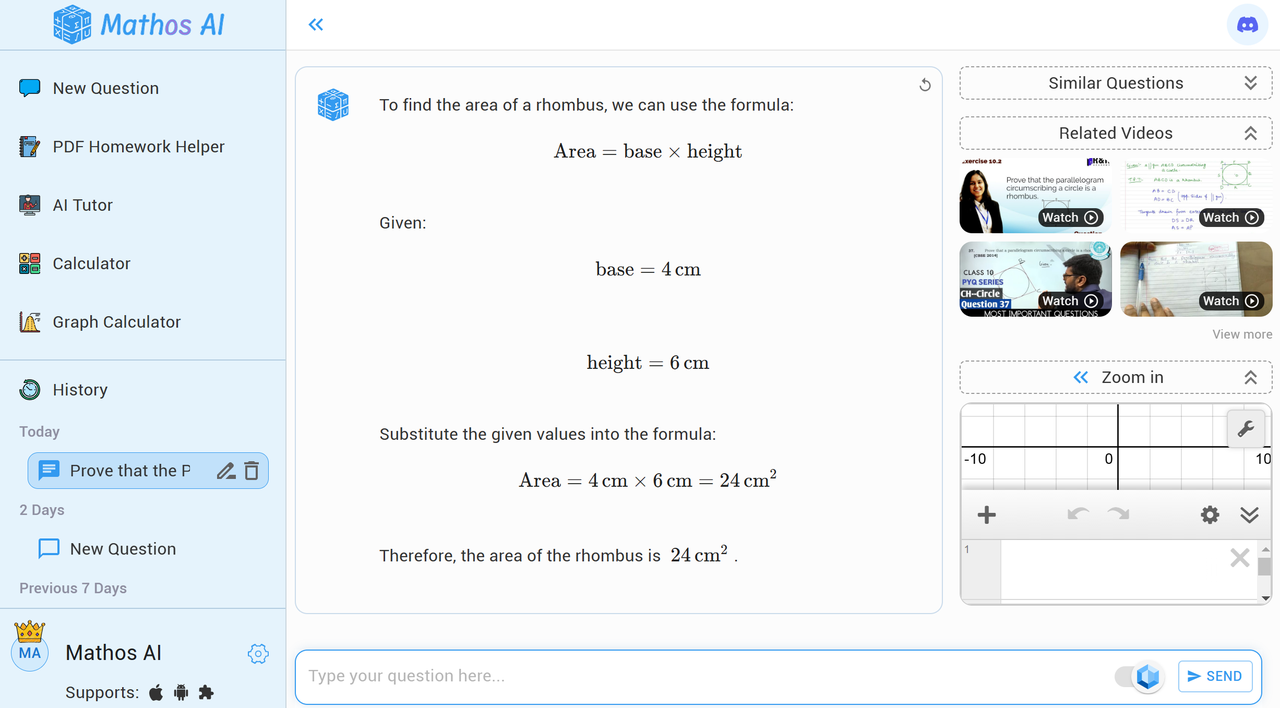
What is the area of a rhombus if the base is cm and the height is cm?
Mathos AI's solution:
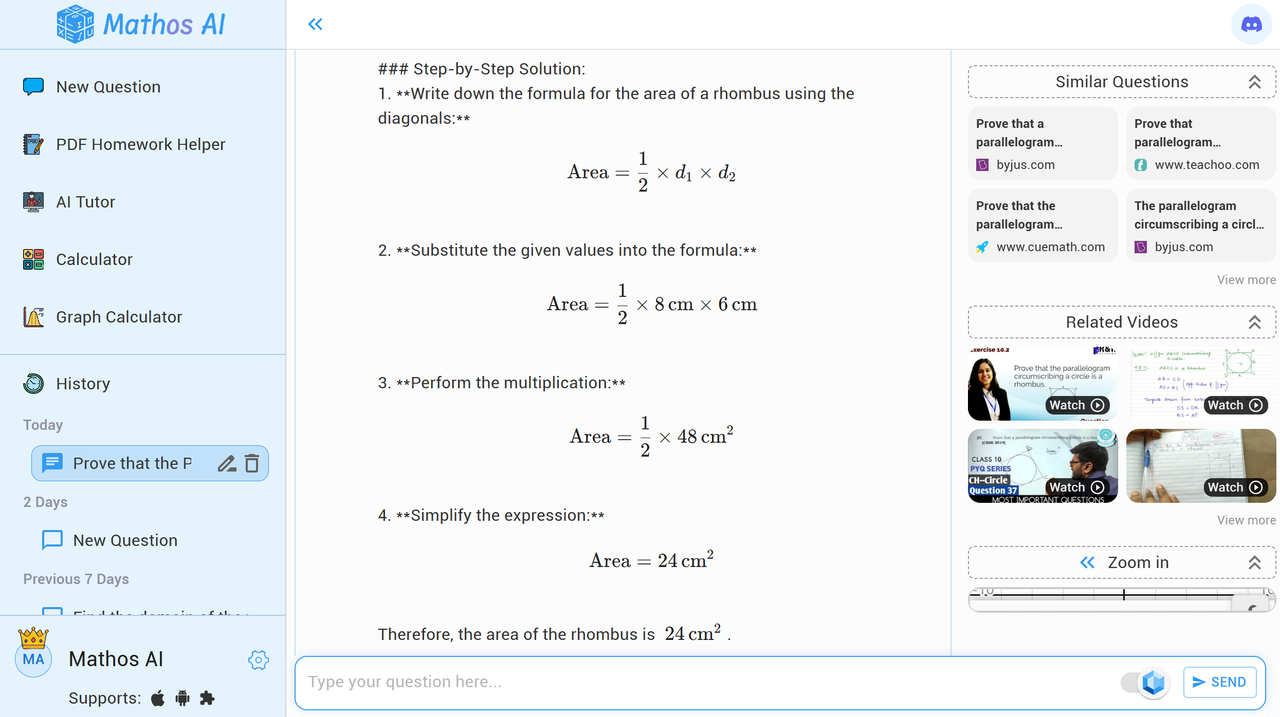
Suppose the lengths of the diagonals of a rhombus are given as and , What is the area of this rhombus?
Mathos AI's solution:
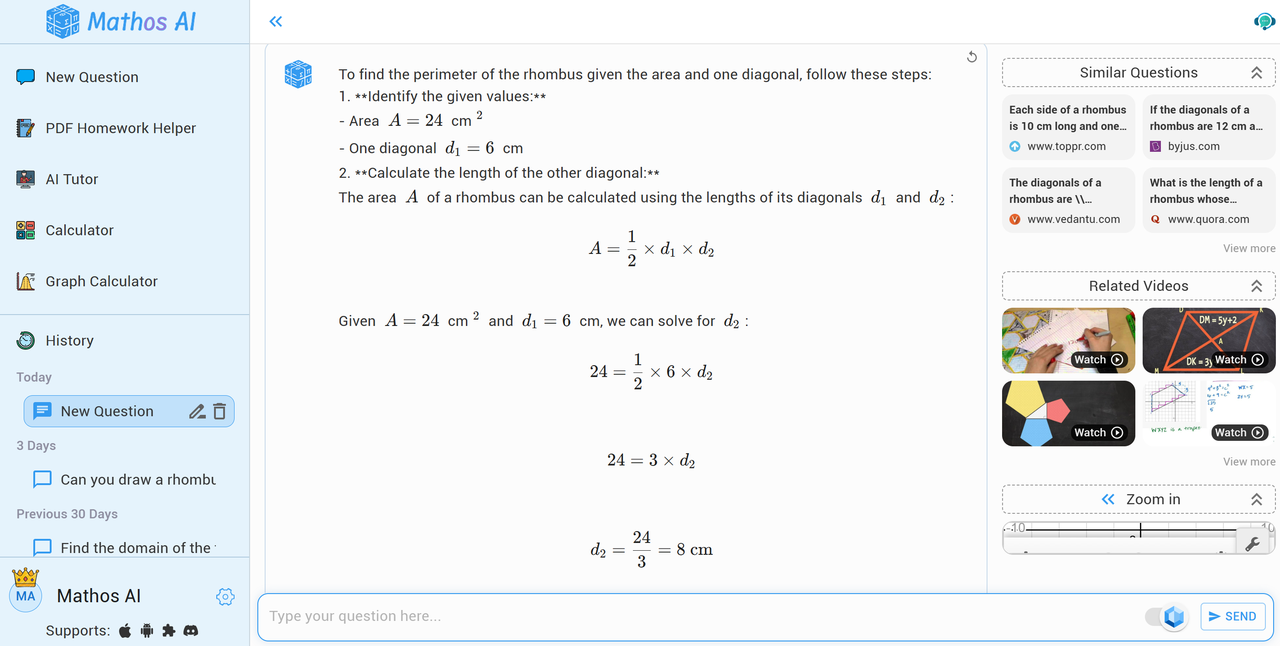
SAT Math Question on Rhombus
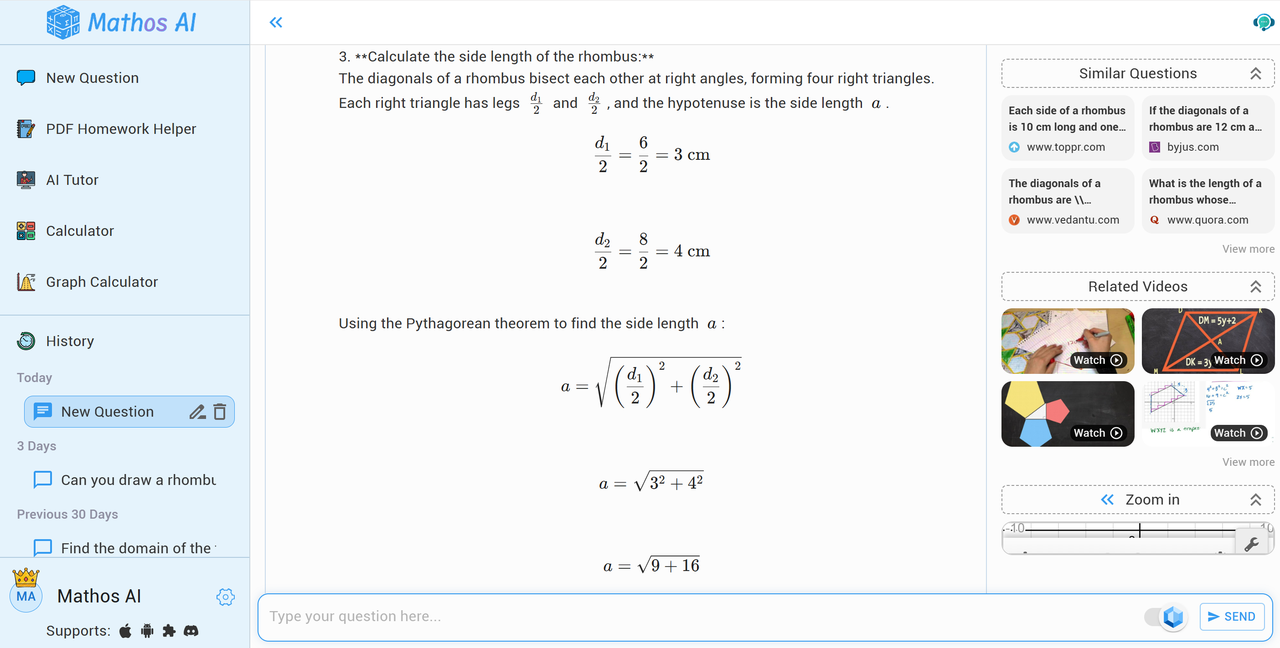
If the area of a rhombus is and one diagonal length is , find the perimeter of the rhombus.
Mathos AI's solution:
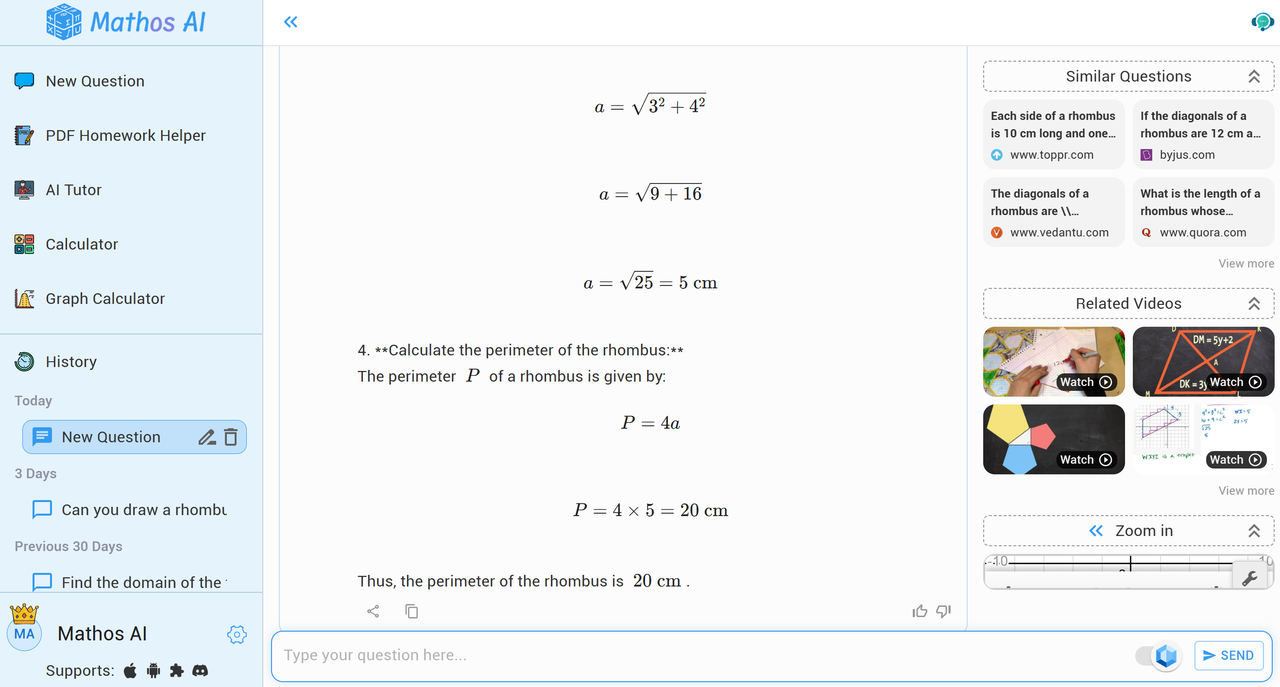
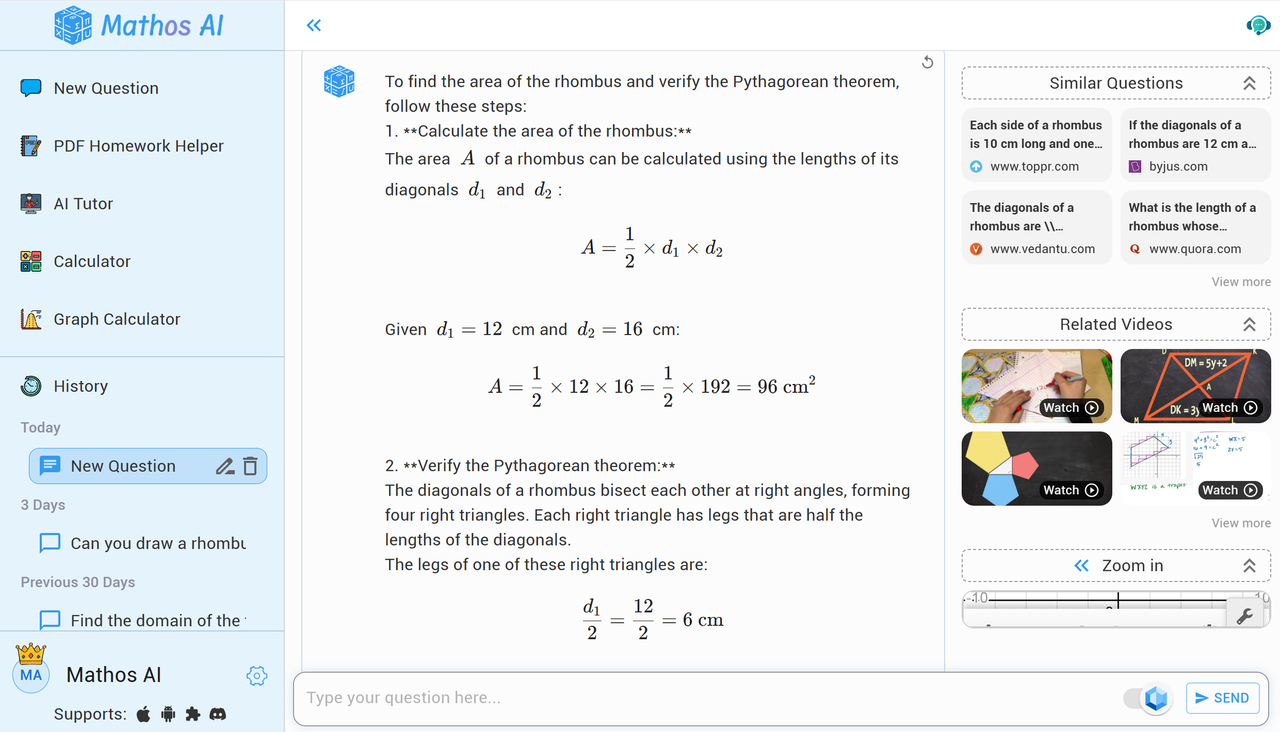
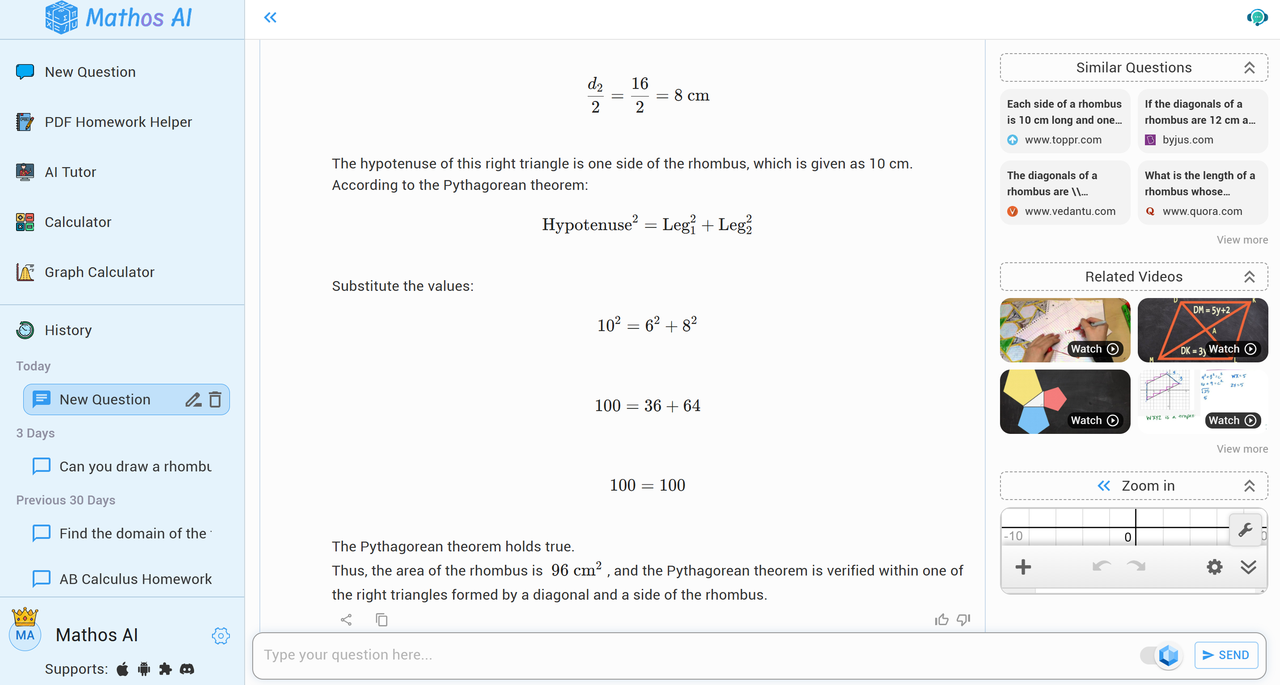
If the diagonals of a rhombus measure cm and cm respectively, and one side of the rhombus measures cm, calculate the area of the rhombus and verify that the Pythagorean theorem holds true within one of the right triangles formed by a diagonal and a side of the rhombus.
Mathos AI's solution:
The rhombus is more than just a shape—it’s a key player in geometry, with unique properties that make it useful in math and real-world applications. Whether you’re calculating its area or marveling at its symmetry, the rhombus is a geometric "gem" worth knowing.
Understanding shapes like a rhombus is just the beginning. Mathos AI is your all-in-one math AI tutor and homework helper, perfect for solving any problem, including algebraic expressions, prime numbers, and polynomial equations. Plus, its beta version is 20% more accurate than even GPT-4, so you can rely on precise and helpful guidance every time.
With functionalities like a graphing calculator to explore a simple linear function or solve intricate equations, and a PDF homework helper to tackle textbook questions, allowing you to modify, annotate, and take notes within your study materials. Mathos AI makes math easy and fun. From algebra to geometry, it provides tailored, step-by-step explanations to match how you learn.
Whether you’re working on parametric equations, scientific notation, or Laplace transform, Mathos AI is here to help you every step of the way. Ask Mathos AI Questions today!