
Mastering Laplace Transform with Laplace Transform Calculator
Monday, November 4, 2024

Have you ever been given a math problem only to wonder if it belonged in a nightmare puzzler? One of those complex differential equations makes you wonder why you were taking the class in the first place. Well, if you don’t know where to begin, I have good news: the Laplace transform is here to save the day. It helps break down complicated problems into something you can solve.
Whether you’re a student trying to keep your head above water or a professional dealing with high-level math, understanding the Laplace transform meaning can make a world of difference. And don’t worry, I’ll walk you through the basics, from its key properties to how a Laplace transform calculator can simplify your life.
What is Laplace Transform?
So, what exactly is the Laplace transform? Simply put, it’s a mathematical process that turns a vector function in the time domain (usually named as into the frequency domain (usually named ). Never fear, it’s not as scary as it sounds. The main goal of the Laplace transform is to simplify the process of solving differential equations, making them easier to handle, especially in fields like engineering and physics. In essence, the Laplace transform is like a magic trick for math. It helps you switch gears from dealing with complex differential equations to something far simpler: algebra. This trick makes Laplace transform into an incredibly valuable tool for solving problems in control systems, signal processing, and dynamic systems. The formula for the Laplace transform is given by:
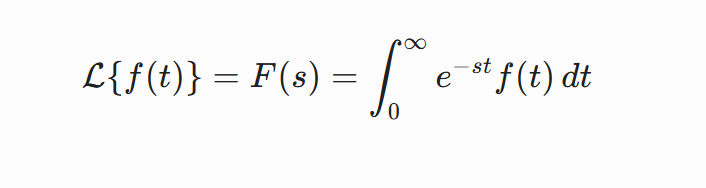
Here, is the time variable, and sss is a complex frequency variable. The idea is to take your function (which could represent a physical process or a signal), multiply it by , and then integrate it from 0 to infinity. The result is a transformed function , which exists in the complex frequency domain.
Properties of Laplace Transform
Now that you know what the Laplace transform is, let’s get into the nitty-gritty details—the properties. These properties make Laplace transform into a versatile tool for solving a variety of problems in mathematics and engineering.
- Laplace Transform of
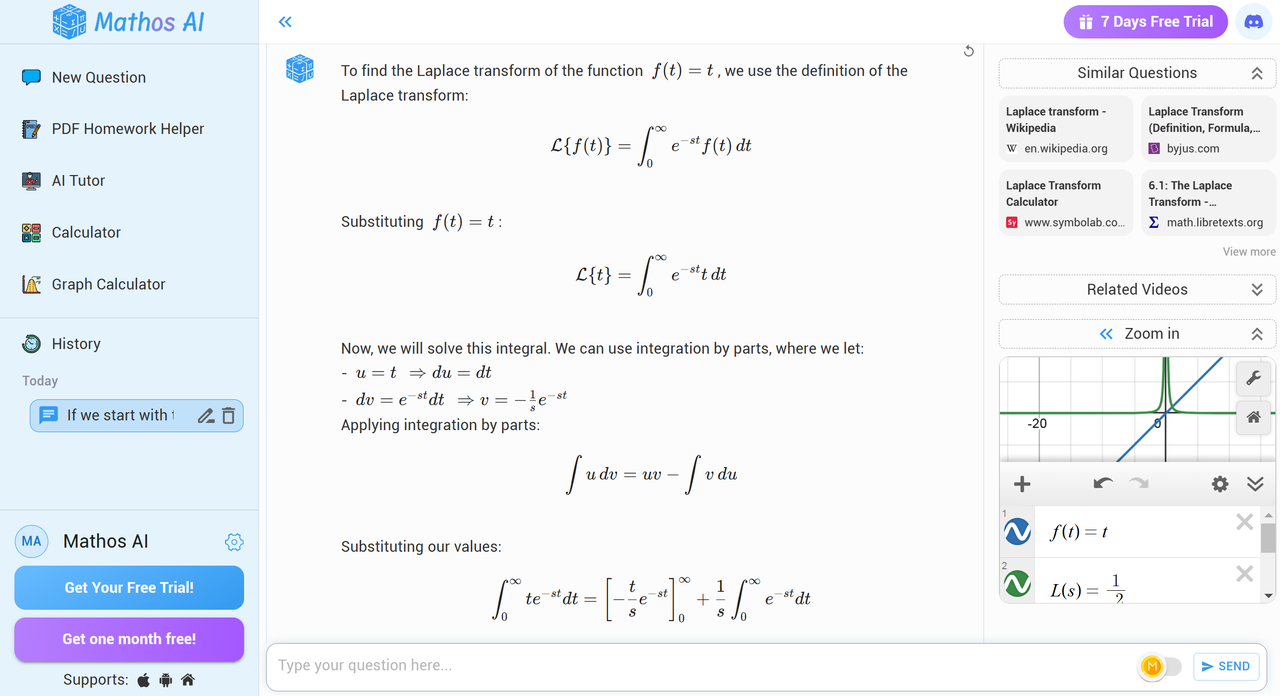
The Laplace transform of is quite straightforward. If we start with the basic function , the Laplace transform is:
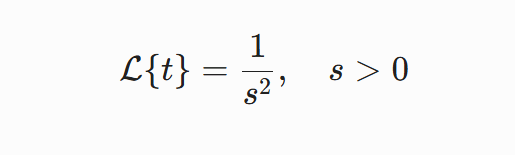
This is a simple yet powerful example of how the Laplace transform takes a linear time function and converts it into an algebraic expression in terms of .
Ask Mathos AI to explain this to you:
- Inverse Laplace Examples
The inverse Laplace transform is the process of converting a function in the -domain back to the time domain. Suppose we have a function in the frequency domain, . The inverse Laplace transform brings it back to . For example: Let's find out the inverse Laplace transform of this function: .
Mathos AI's answer:
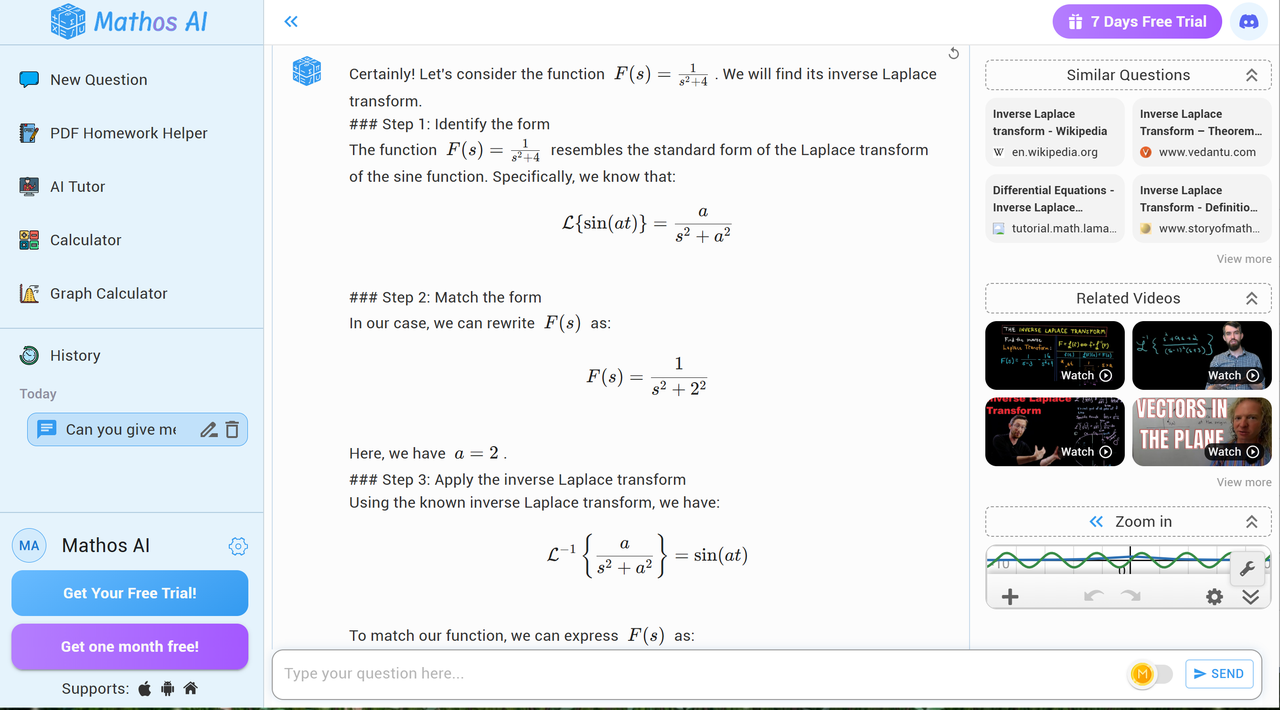

This property is key in solving differential equations where you first apply the Laplace transform, solve the equation in the algebraic domain, and then take the inverse Laplace transform to get back to the time domain.
Laplace Transform Table
For anyone who regularly works with the Laplace transform, having a Laplace transform table at your fingertips is essential. This table summarizes common functions and their corresponding Laplace transforms, making it a quick reference for students and professionals alike. Here are some standard entries:

Key:
- is the Dirac delta function;
- is the unit step function;
- and are constants;
- denotes the factorial of ;
This Laplace transform table is a go-to resource for quickly solving problems related to differential equations and system analysis.
How to Do Laplace Transform?
Now that we’ve covered the basics, you might be wondering: how do I do a Laplace transform? That’s not rocket science. The process is simple, and with tools like Mathos AI’s Laplace Transform Calculator, it becomes even easier.
Here’s a step-by-step guide:
- Write down the function that you want to transform.
- Multiply the function by , where sss is a complex number.
- Integrate the product concerning , from 0 to infinity.
- Simplify the result to get the transformed function .
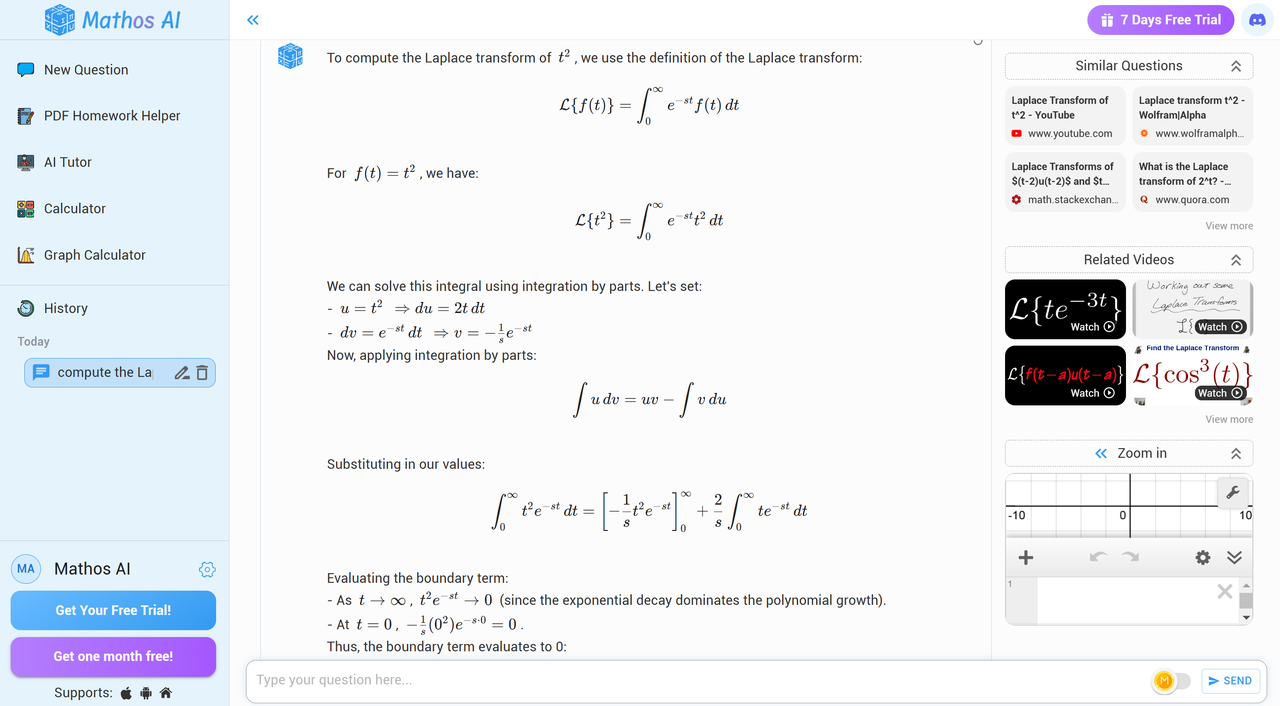
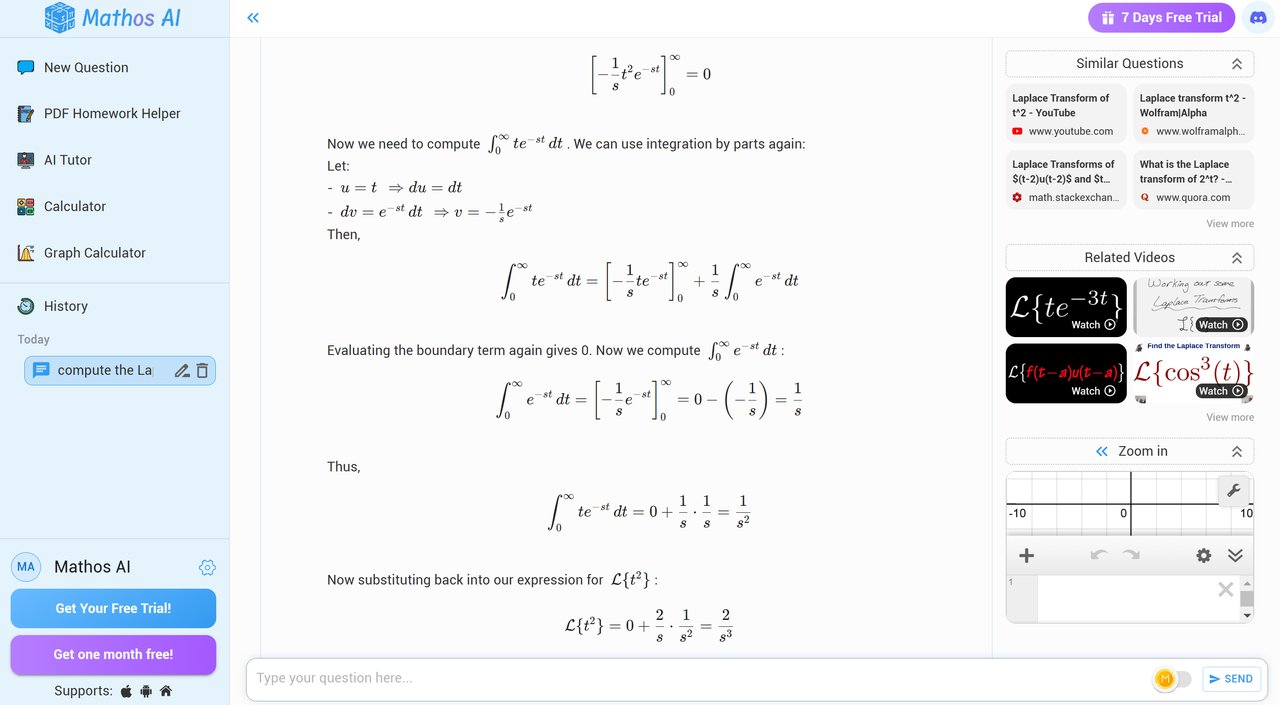
For example, if you want to compute the Laplace transform of , and find manual work sounds too tedious, just plug the function into Mathos AI’s Laplace Transform Calculator, and you’ll get the result in seconds—along with a detailed step-by-step breakdown, just like this:
FAQs About Laplace Transform
I've compiled some of the FAQs about Laplace transform students ask during their math studies. See how Mathos AI answers these math questions.
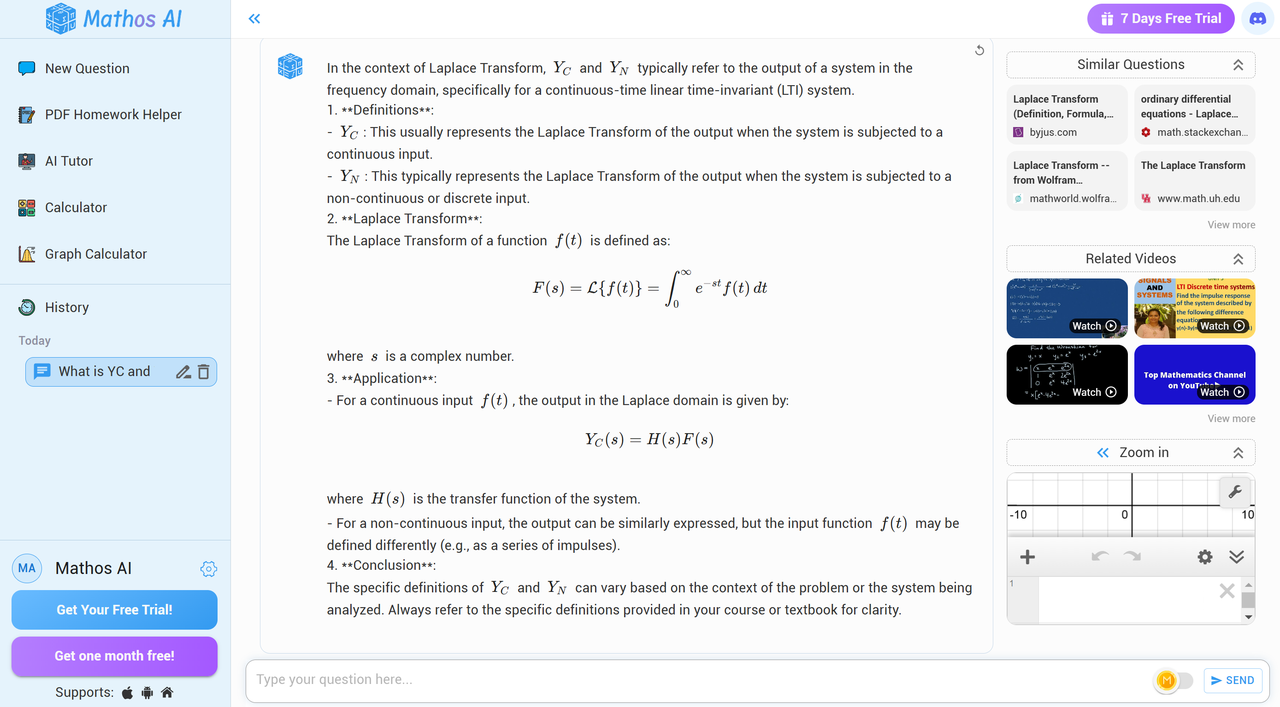
What is YC and YN in Laplace Transform?
Mathos AI's answer:
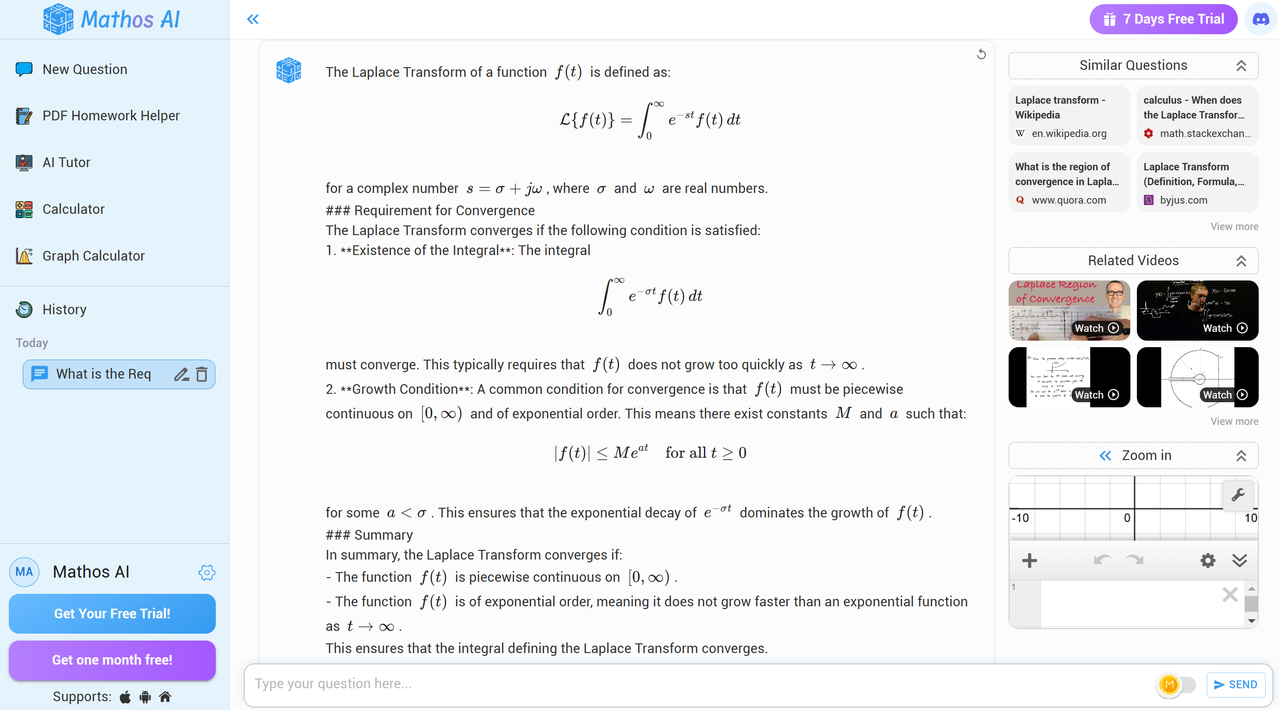
What is the Requirement for Laplace Transform to Converge?
Mathos AI's answer:
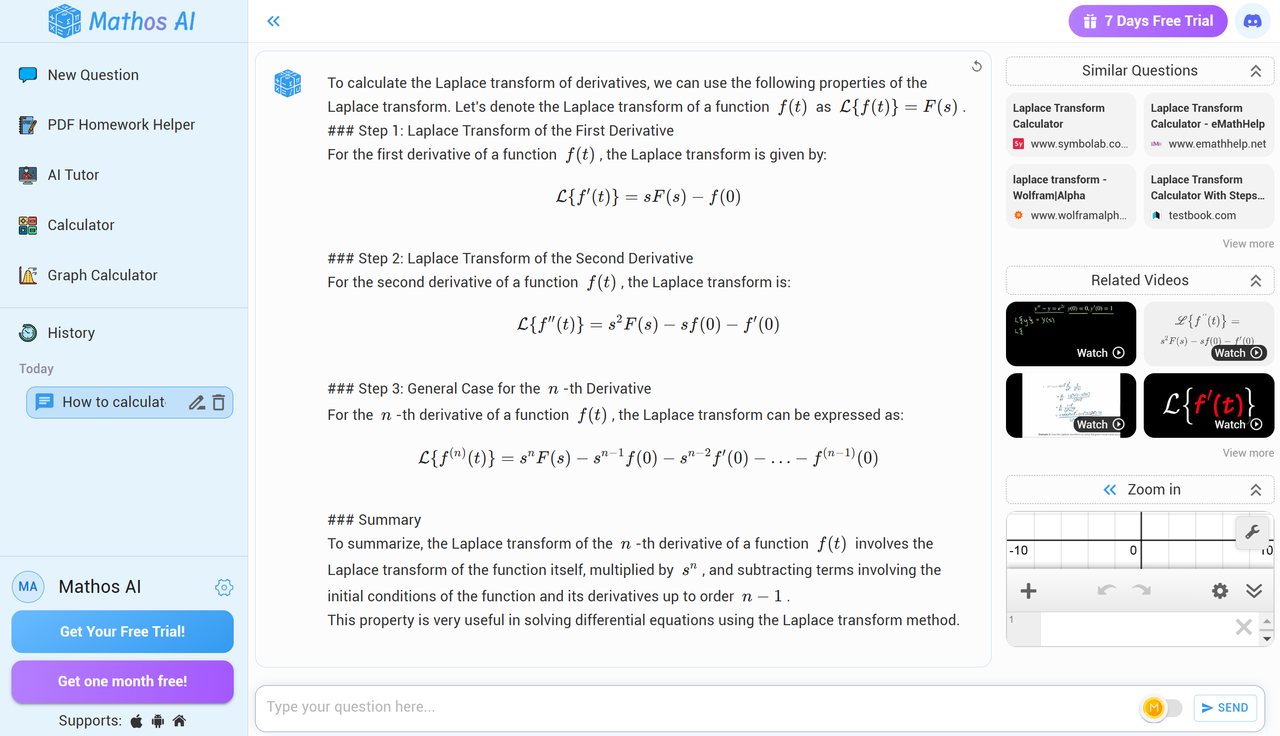
How to Calculate the Laplace Transform for Derivatives?
Mathos AI's answer:
Mathos AI is in Your Corner
Now that you’ve journeyed through the world of Laplace transforms—from understanding the Laplace transform meaning to discovering its incredible properties—you’re probably wondering, "How do I apply all of this without pulling my hair out?" That’s where Mathos AI comes in as the superhero sidekick that you never knew you wanted. With its powerful Laplace transform calculator, Mathos AI not only helps you tackle these complex equations but also shows you the steps in a way that makes sense. Whether you’re working on a scientific notation or a question about integrals, Mathos AI will have you feeling like you have the ultimate math cheat code. Are you ready to reduce time, energy, and frustration in spades? If you ever hesitate about math problems on your homework? Then try Mathos AI PDF Homework Helper. Mathos AI PDF Homework Helper simplifies math homework tasks. You can solve problems directly on PDFs by circling questions and obtaining step-by-step solutions. Additionally, you can modify, annotate, and take notes on your study materials.