
Introduction to the Unit Circle: Formulas, Sine, Cosine Functions and Quizzes in Trigonometry
Thursday, December 12, 2024

The unit circle—a perfect circle with endless uses in math. Whether it’s helping you ace your next trigonometry quiz, or making tricky angles a piece of cake, understanding the unit circle is like finding a treasure chest full of math secrets. You’ll learn how the unit circle chart connects everything from radians to trigonometric functions like sine and cosine. And yes, we’ll even touch on how it works with tools like the unit circle calculator and fun stuff like unit circle quizzes!
What is the Unit Circle?
The unit circle is a special circle with a radius of exactly one. Picture this: a perfectly round circular unit centered at on a graph. Its simple equation——holds all the rizz. This unit circle equation shows that every point in the circle is just unit away from the center. These relationships, based on the unit circle equation, make it a go-to tool in trigonometry.
But what’s the big deal? Well, the unit circle formulas come into play here. These formulas connect the coordinates of any point on the circle to trigonometric functions:
- Sine () is the -coordinate.
- Cosine () is the -coordinate.
- Tangent () is the ratio of sine to cosine.
With it, you can explore sine, cosine, and even the tan unit circle (that’s tangent, for the uninitiated).
The Unit Circle Chart Displays
The unit circle chart is a visual representation of the unit circle, a fundamental concept in trigonometry. The unit circle is a circle with a radius of 1 unit, centered at the origin of a coordinate plane . This chart is used to understand angles, trigonometric functions, and their relationships with the coordinates of points on the circle
Components of a Unit Circle Chart:
Circle: A perfect circle with a radius of .
Angles:
- Measured in degrees to or radians ( to ).
- Angles start from the positive -axis and rotate counterclockwise.
Coordinates:
- Each point in the circle corresponds to an angle and has coordinates , where is the angle formed with the positive -axis.
Special Angles:
- Commonly labeled angles include , , , , and , along with their equivalents in other quadrants.
- These angles are often marked with their sine and cosine values.
Quadrants:
The circle is divided into four quadrants, each affecting the sign of and :
- Quadrant I: Both sine and cosine are positive.
- Quadrant II: Sine is positive, cosine is negative.
- Quadrant III: Both sine and cosine are negative.
- Quadrant IV: Sine is negative, cosine is positive.
How the Unit Circle Chart Helps:
Trigonometric Functions:
The -coordinate and -coordinate represent the cosine and sine values of an angle.
The tangent of the angle is given by , except where .
Understanding Periodicity:
It shows how sine, cosine, and tangent values repeat as the angle completes rotations. The chart simplifies calculations of trigonometric values for standard angles.
The unit circle is centered at the origin of a coordinate plane. Any point on the circle can be represented by its coordinates . These coordinates are related to the angle formed by a line drawn from the origin to the point and the positive -axis. The unit circle chart shows common angles and their corresponding coordinates on the unit circle.
What are the 4 parts of the unit circle?
The unit circle is divided into four parts, known as quadrants. Each quadrant corresponds to a specific range of angles and has distinct characteristics regarding the signs of the sine and cosine functions. Here are the details of each quadrant:
First Quadrant (Quadrant I)
Angle Range: to (or to radians)
Coordinates: Both and coordinates are positive.
Sign of Trigonometric Functions:
Second Quadrant (Quadrant II)
Angle Range: to (or to radians )
Coordinates: coordinate is negative, coordinate is positive.
Sign of Trigonometric Functions:
Third Quadrant (Quadrant III)
Angle Range: to (or to radians)
Coordinates: Both and coordinates are negative.
Sign of Trigonometric Functions:
Fourth Quadrant (Quadrant IV)
Angle Range: to (or to radians)
Coordinates: Both and coordinates are negative.
Sign of Trigonometric Functions:
Trigonometry and the Unit Circle: What’s the Relation?
Trigonometry might sound intimidating, but the unit circle makes it way easier. Imagine drawing a line from the circle’s center to any point on its edge. That line (called a radius) forms an angle with the -axis.
- The -coordinate of that point equals the cosine ) of the angle.
- The -coordinate equals sine ().
- The ratio of to gives you the tangent ().
This combo of unit circle sin cos tan helps solve problems in everything from geometry to physics. Plus, by dividing the circle into four parts called unit circle quadrants, you can figure out whether your trig values are positive or negative—super handy for quizzes!
How to Easily Learn the Unit Circle
Learning the unit circle might initially sound tricky, but trust me—it’s not rocket science. With the right approach and a pinch of patience, you’ll master it in no time. The unit circle chart is your ultimate cheat sheet, showing all the angles, coordinates, and connections between sine, cosine, and tangent. Let’s break it down so that even elementary students can become pros.
Start with the Basics
First, remember that the unit circle is just a circle with a radius of one. That’s it! Think of it as a radian circle because it measures angles in radians instead of degrees. Angles like , , , , , and their multiples are your go-to points. These are like stops on a subway map—they help you navigate the circle.
Use a Visual Guide
Grab a unit circle chart. It’s your secret weapon! This chart maps every angle to its corresponding sine and cosine values. For example:
- At , cosine is , and sine is .
- At , cosine is , and sine is .
- At , cosine is -1, and sine is 0. You’ll notice a pattern emerging that’s easy to memorize once you study it visually.
Play Games and Take Quizzes
Who said math can’t be fun? Try a unit circle quiz or play interactive unit circle games online. These are fantastic tools to test your knowledge while laughing. Games make learning angles, radians, and coordinates feel less like studying and more like a fun challenge.
If you are wondering how to memorize the unit circle, here’s a pro tip: practice using patterns. Angles repeat in every quadrant, so once you learn one, you’re halfway there. Pairing study time with a unit circle game can also make learning fun and evoke your memories of learning the unit circle radians or quadrants.
Use a Unit Circle Calculator
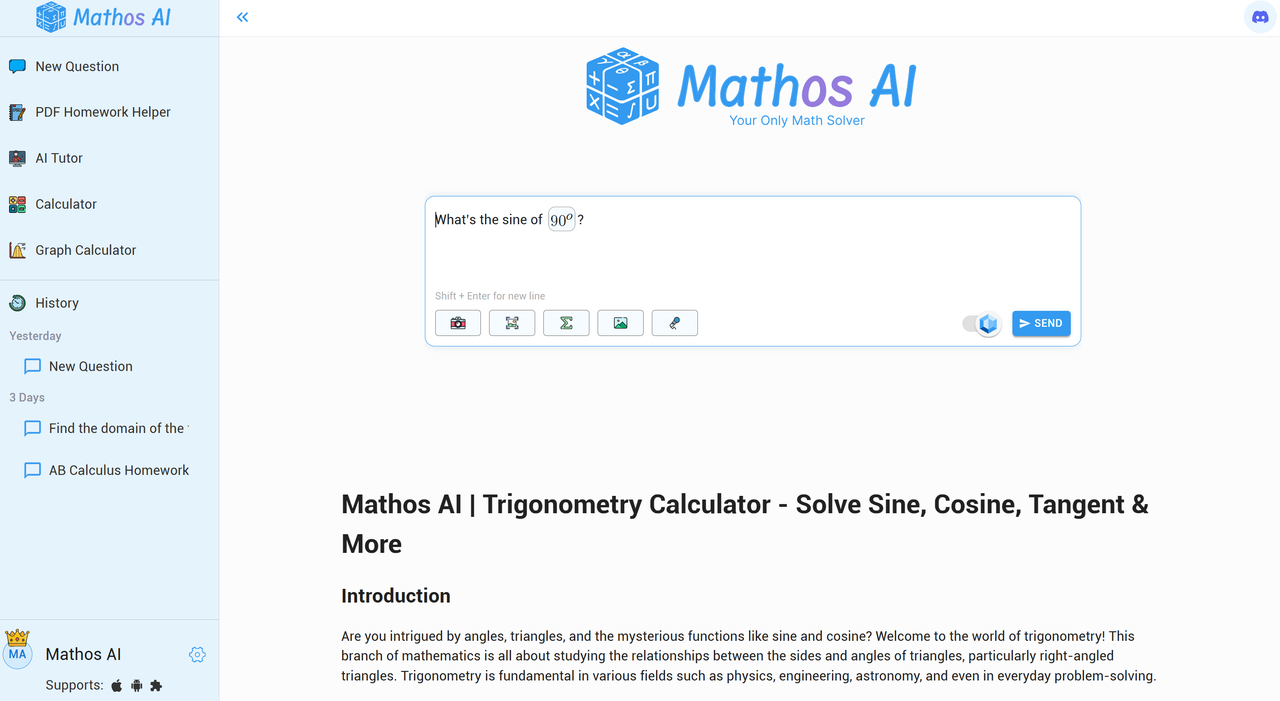
When in doubt, let technology help. A unit circle calculator is "a gem" that can quickly confirm your answers or show you step-by-step solutions. This is especially handy when figuring out sine, cosine, or tangent for less obvious angles. If you want to learn more about trigonometry, then use Mathos AI's Trigonometry Calculator to solve more trigonometric questions for you, letting you visualize sine, cosine, tangent, and more. Before tapping into your unsolved questions, you can learn some trigonometry background first.
Make It a Daily Habit
Practice, but don’t overdo it. Spend just 10-15 minutes a day reviewing the unit circle chart and testing yourself with a unit circle quiz. In no time, you’ll feel confident explaining radians and angles to your friends.
With these tips, learning the unit circle can be simple, interactive, and even enjoyable!
How to Find Reference Angles NOT on the Unit Circle
To find the reference angle for an angle that is not one of the standard angles on the unit circle, follow these steps:
- Identify the Quadrant: Determine which quadrant the given angle lies in. This will help you decide how to calculate the reference angle.
- Calculate the Reference Angle:
First Quadrant: If the angle is in the first quadrant, the reference angle is itself.
Second Quadrant: If the angle is in the second quadrant, the reference angle is .
Third Quadrant: If the angle is in the third quadrant, the reference angle is .
Fourth Quadrant: If the angle is in the fourth quadrant, the reference angle is .
- Convert to Radians if Necessary: If the given angle is in degrees, convert it to radians first using the conversion factor.
To Help You Understand:
Find the reference angle for :
- Convert to Radians:
-
Identify the Quadrant: Since is between and , it lies in the third quadrant.
-
Calculate the Reference Angle:
So, the reference angle for (or radians) is .
Find the reference angle for :
- Convert to Radians:
-
Identify the Quadrant: Since is between and , it lies in the fourth quadrant.
-
Calculate the Reference Angle:
So, the reference angle for (or radians) is .
By following these steps, you can find the reference angle for any given angle, whether it is in the unit circle or not.
What Does Sin, Cos, and Tan Represent in the Unit Circle?
In the context of the unit circle, the trigonometric functions sine (), cosine (), and tangent () have specific geometric interpretations. The unit circle is a circle with a radius of 1 centered at the origin in the coordinate plane. Here's what each function represents:
Sine ()
For an angle measured from the positive -axis, the sine of is the -coordinate of the point where the terminal side of the angle intersects the unit circle.
Cosine ()
For an angle measured from the positive -axis, the cosine of is the -coordinate of the point where the terminal side of the angle intersects the unit circle.
Tangent ()
The tangent of an angle is the ratio of the sine of the angle to the cosine of the angle. Geometrically, it can be interpreted as the slope of the line that passes through the origin and the point on the unit circle.
- Sine ): The -coordinate of the point on the unit circle.
- Cosine (): The -coordinate of the point in the unit circle.
- Tangent (): The ratio of the -coordinate to the -coordinate of the point on the unit circle.
What is Tan Unit Circle?
The tangent function on the unit circle is a way to understand the tangent of an angle in terms of the coordinates of points on the unit circle. The unit circle is a circle with a radius of 1 centered at the origin of the coordinate plane.
For an angle measured from the positive x-axis, the coordinates of the corresponding point on the unit circle are . The tangent of the angle is defined as the ratio of the -coordinate to the -coordinate of this point:
The tangent function is undefined where , which occurs at for any integer . These are the points where the angle corresponds to the vertical lines on the unit circle.
The tangent function has a period of , meaning .
Signs in Different Quadrants:
Quadrant I: is positive (both and are positive).
Quadrant II: is negative ( is positive, is negative).
Quadrant III: is positive (both and are negative).
Quadrant IV: is negative ( is negative, is positive).
Example Values:
- is undefined
- is undefined
Examples To Improve Your Understanding:
Consider the angle (or ):
- Coordinates on the Unit Circle:
- Sine:
- Cosine:
- Tangent:
Understanding these relationships helps in solving various trigonometric problems and in visualizing the behavior of these functions in the unit circle.
Test Your Knowledge: Unit Circle Quiz
Think you’ve got it? Try this:
- What’s the sine of ?
- In which quadrant is positive?
- Use the unit circle tangent formula to find for .
Before you check for the solution from Mathos AI, make sure you have written these unit circle questions down on paper and tried to solve them by yourself first. Because without you practicing on your own, what's the point?
Now let's see how Mathos AI solves these three unit circle questions:
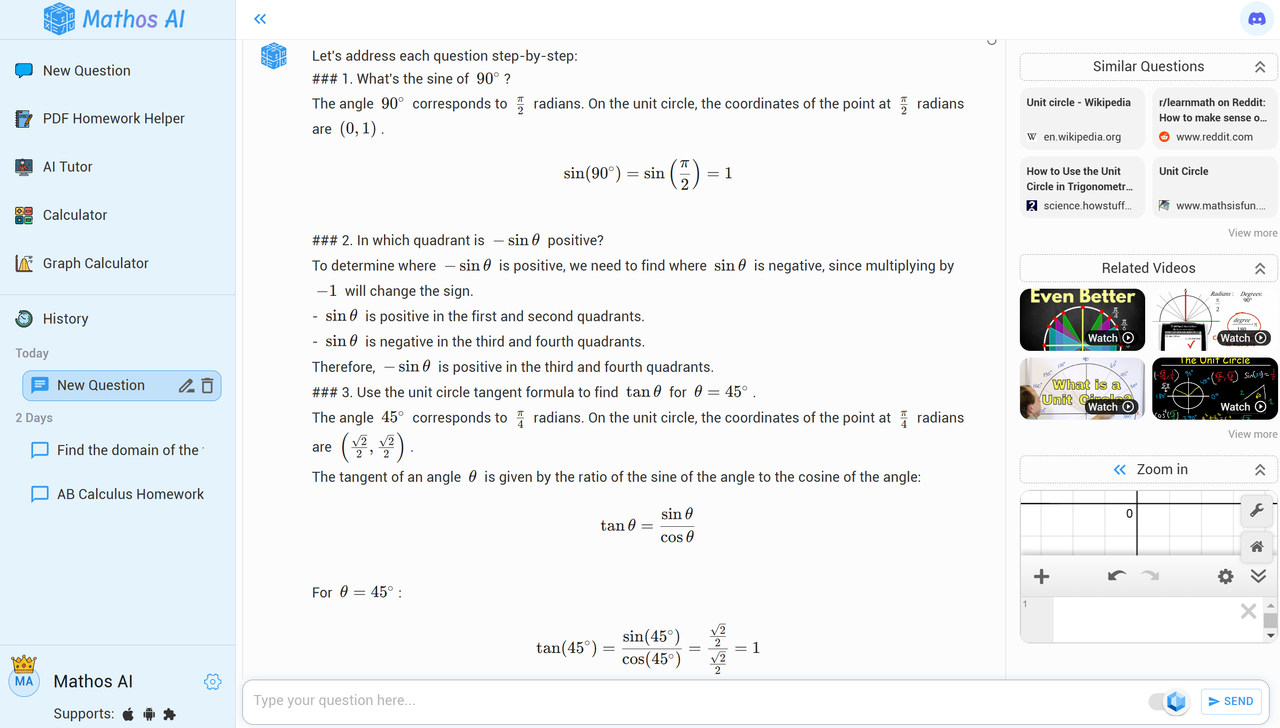
Answer:
- is positive in the third and fourth quadrants.
Practice makes perfect!
Let Mathos AI Be Your Study Partner
Mastering math topics like the unit circle, algebraic expressions, or even polynomial equations doesn’t have to be hard. With Mathos AI, you can simplify your learning journey.
Trusted by over 2 million, Mathos AI combines a powerful graphing calculator, all-in-one math calculators, and an AI tutor to help you understand and solve complex problems step by step. Do you need help plotting trigonometry or solving a tricky equation? Mathos AI offers instant and accurate solutions with explanations tailored to your pace and style. Mathos AI’s solutions are built on an advanced model that offers 20% higher accuracy than ChatGPT. So you can confide in the answer Mathos AI provides. Need help with assignments? Use the PDF Homework Helper: Upload, edit, or snap photos of your assignments for quick, reliable answers. It’s like having a tutor available 24/7.
Get the answers you need and build your math confidence today with Mathos AI—your only math solver. Ask Mathos AI Question today!