
How to Find a Math Tutor in 2025
Wednesday, February 5, 2025
Struggling to find the right math tutor? With so many options available in 2025, from traditional private tutors to AI-powered platforms, choosing the best fit for a student’s needs can be overwhelming.
In this article, we will provide a comprehensive guide on how to find a math tutor, covering all the key factors you might need but could easily overlook. From understanding the importance of matching a tutor’s teaching style to your child’s learning needs to exploring the latest advancements in private tutor services, this guide will help you navigate the evolving landscape of tutoring in 2025.
In-person Tutoring or Online Tutoring, Choosing the Right Mode of Tutoring
In-person tutoring remains the preferred choice for young learners, who benefit from face-to-face interaction and structured learning environments. Having a tutor physically present helps with engagement, discipline, and hands-on learning, making it ideal for foundational math concepts.
For more mutured and independent students, online tutoring is becoming increasingly popular. Many don’t need full-length lessons but rather targeted support, such as help with specific problems or exam preparation. Online platforms offer greater flexibility, accessibility, and making learning more efficient.
Meanwhile, hybrid tutoring is emerging as a practical middle ground, combining the convenience of online sessions with the personalized touch of in-person meetings, along with advanced AI-powered tools, such as Mathos AI. This approach is ideal for students who need structured support for complex topics while maintaining the flexibility to study at their own pace.
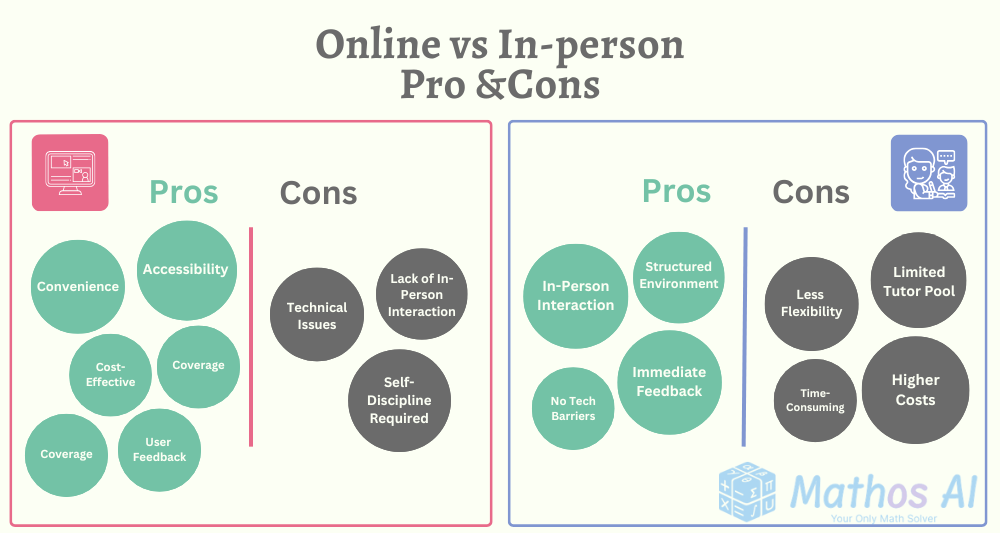
Below, we’ll break down the pros and cons of each mode to help you choose the best option.
| Pros | Cons | |
|---|---|---|
| In-Person Tutoring | - In-Person Interaction: Face-to-face communication can enhance understanding | - Limited Tutor Pool: Restricted to tutors available in your local area. |
| - Structured Environment: Traditional classroom-like settings can help students stay focused and disciplined. | - Less Flexibility: Requires travel to a specific location and fixed schedules. | |
| - Immediate Feedback: Tutors can provide hands-on guidance and address questions in real time. | - Higher Costs: Often more expensive due to travel and facility expenses. | |
| - No Tech Barriers: No need to worry about internet issues or device compatibility. | - Time-Consuming: Commuting to and from tutoring sessions can eat into valuable time. | |
| Online Tutoring | - Convenience: Learn from anywhere with an internet connection. | - Lack of In-Person Interaction: May feel less personal compared to face-to-face tutoring. |
| - Accessibility: Connect with highly qualified tutors worldwide, not limited to local options. | - Technical Issues: Poor internet connectivity or device problems can disrupt sessions. | |
| - Flexibility: Schedule sessions at any time, making it easier to balance school, extracurriculars, and tutoring. | - Self-Discipline Required: Students need to stay focused and motivated in a virtual environment. | |
| - Cost-Effective: Often more affordable than in-person tutoring due to reduced overhead costs. | ||
| - Coverage: Easily find specialized tutors for niche topics or advanced levels. | ||
| - User Feedback: Platforms often feature reviews and ratings from many users, allowing you to evaluate tutors based on feedback from other students and parents. | ||
| Hybrid Tutoring | - Best of Both Worlds: Combines the flexibility of online tutoring with the personal touch of in-person sessions, and AI-powered tools. | |
| - Best of Both Worlds: Combines the flexibility of online tutoring with the personal touch of in-person sessions, and AI-powered tools. | ||
| - Growing Popularity: Increasingly adopted in 2025 as technology bridges the gap between online and offline learning. |
Understanding the Needs of the Student
Now that you know the different tutoring modes available, the next step is ensuring the tutor matches the student’s specific learning needs.
Every student has unique challenges, and tailoring tutoring sessions to address these is key to maximizing learning outcomes.
One important factor to consider is the grade level. A child in elementary school may need a private tutor for foundational skills in reading, math, and writing, while a high school or college student might require targeted homework helper for their assignments of advanced subjects, or someone specializing in college entrance exams preparations. Whether they are preparing for the syllabus of SAT, A-Levels, GCSE, IB, AP, or completing advanced subjects, such as calculus, ensuring that the tutor is familiar with the relevant curriculum and syllabus is essential. Beyond academics, a student's learning style and tutoring objectives play a crucial role in selecting the right support. Some students need regular assistance with homework tutoring, while others seek intensive exam preparation. For those with a keen interest in subjects like mathematics, a math tutor for extracurricular tutoring classes can offer enrichment beyond school learning. Particularily, in math learning, for instance, graphing and 3D geometry might be intuitive for a visual learner but difficult for someone who learns better through hands-on activities. In such cases, using interactive graphing tools or 3D models can make a huge difference. Understanding these differences can help parents and students filter their tutoring options effectively.
Step-by-Step Guide to Choosing a Private Math Tutor
So much for the theory—let’s get into the practical steps of finding the right math tutor in 2025. Here’s a step-by-step guide to help you navigate the process efficiently.
Step 1: Pinpoint What You Need
Before reaching out to a tutor, it’s crucial for parents or students to clarify their specific needs. The more precise the answers, the easier it is to find the right match. Here are some key questions to consider:
- Which areas of math do you find most challenging? (e.g., algebra, calculus, geometry, statistics)
- Are you preparing for a specific exam? (e.g., SAT, A-Levels, IB Math, AP Calculus, national curriculum tests)
- Do you need help with homework, or do you want a tutor to go through the full theory of the basics?
- Do you prefer step-by-step explanations, visual aids, or hands-on problem-solving?
- Would you benefit from interactive digital tools, or do you learn better through face-to-face discussions? Having clear answers to these questions will make the search process much more efficient, helping you connect with a tutor who aligns with your learning needs faster.
Step 2: Choose the Right Mode of Tutoring
The student’s schedule, lifestyle, and study habits play a crucial role in deciding between online, in-person or hybrid tutoring.
- Online tutoring is ideal for students with packed schedules who need flexible session times.
- In-person tutoring works better for those who focus better in structured, face-to-face environments.
- Hybrid tutoring allows students to attend in-person lessons for core learning while reinforcing concepts online.
For example, a student with intensive school and extracurricular commitments might find hybrid tutoring more practical—learning online during busy weeks and attending in-person lessons when extra reinforcement is needed.
Step 3: Where to Find a Tutor?
With so many tutoring options available, parents and students need to explore different avenues to find the best match.
A. Searching for In-Person Tutors
- Use Google to search “math tutor near me” and check tutoring centers nearby.
- Visit local learning centers or libraries that offer math tutoring programs.
- Ask teachers, classmates, or school counselors for word-of-mouth recommendations.
B. Finding Tutors Online
- Dedicated tutoring websites like Wyzant, Chegg Tutors, or TutorMe offer pre-vetted professionals.
- Freelance platforms like Fiverr, Upwork, and Preply allow students to hire independent math tutors from anywhere.
- Social media communities and forums (Facebook groups, Reddit, Discord) often have recommendations for top-rated tutors.
Trying different platforms allows parents and students to compare tutor qualifications, pricing, reviews, and availability before making a decision.
Step 4: Evaluating and Selecting the Right Tutor
After shortlisting potential tutors, it’s important to assess them based on:
- Qualifications & experience (background in teaching, math degree, tutoring experience)
- Teaching style (structured lessons vs. flexible Q&A sessions)
- Student reviews & ratings
- Trial sessions (most tutors offer a free or discounted first lesson)
A trial class is a great way to see whether the tutor’s teaching approach aligns with the student’s needs before committing to long-term sessions.
ChatGPT or AI-powered tutoring tools?
AI-powered tutoring tools have revolutionized math learning in 2025, making high-quality support more affordable, accessible, and personalized. These platforms adapt to a student’s progress, offering instant feedback, step-by-step solutions, and interactive exercises, ensuring they master concepts at their own pace.
It is especially useful for self-motivated learners, students who prefer on-demand help, or those who need extra support alongside human tutoring.
One of the biggest advantages is cost-effectiveness—while private tutors charge 100 dollars per session, online or in-person, AI tutoring tools offer subscription plans as low as 30 per month, making quality tutoring more accessible to a wider range of students.
Many students today rely on AI-powered tools for math help. While ChatGPT is a great starting point, it still has limitations in solving complex equations accurately. That’s where specialized AI math tools like MathosAI come in—designed specifically for numerical precision, MathosAI boasts a 20% higher accuracy rate. Other alternatives, like Photomath and Mathway,also offer unique features. Before subscribing, consider testing out different platforms to see which one best fits your learning style.
Finding the Right Math Tutor for Success
In 2025, finding a private tutor has never been more accessible, but it is not as simple as just typing "math tutor near me"into Google.
The key is to identify the student’s needs, select the right mode (offline, online, or hybrid), checking tutor qualifications, and consider affordability and accessibility.
Always review tutor credentials, compare pricing, and try a trial session to ensure the best fit for effective learning and academic success. By following this guide, you’ll be equipped to make the best decision for academic success. 🚀